
Company History
Sydney Theatre Company
Sydney Theatre Company was formed in December 1978, following the closure of The Old Tote Theatre Company the month before.
The then Premier, the Honourable Neville Wran, approached Elizabeth Butcher, who had been seconded from NIDA to administer the Old Tote, and asked her to set up a new state theatre company to perform in the Drama Theatre of the Sydney Opera House.
Butcher established its legal identity and managerial structure and proposed the name, Sydney Theatre Company. With John Clark (Director of NIDA) as the Artistic Adviser of the First Season, five theatre companies were invited to suggest six plays to be presented by STC as the 1979 Interim World Play Season in the Drama Theatre.
The first production, in association with The Paris Company, was A Cheery Soul by Patrick White, Australia's Nobel Laureate for Literature, directed by Jim Sharman, featuring Robyn Nevin as Miss Docker.
In June 1979, Richard Wherrett, then one of Nimrod Theatre's co-Artistic Directors, was appointed Artistic Director of STC to plan and organise activities for the 1980 season. The first STC-produced play was The Sunny South by George Darrel which opened on 1 January 1980, with music by Terence Clarke, directed by Richard Wherrett, assisted by John Gaden.
In its early years, the Company operated out of several rented premises around the city, producing 38 productions in five separate venues. Elizabeth Butcher, STC Administrator, was given the task of finding one location that could house all the activities of the company and a theatre.
After an extensive search, Butcher had the vision to propose the derelict Walsh Bay Wharf 4/5 as STC's new home, immediately envisaging the capacity of the building to fulfill all requirements of space, location and additional venue.
On 12 September 1983, after three years of overcoming budgetary and bureaucratic obstacles, Premier Wran announced that the State Government had approved the expenditure of $3.5 million to finance the recycling project. The 60-year-old ironbark timber wharf warehouse built to load cargo onto ships tied up alongside, was converted into premises suitable for creating, producing, performing and enjoying theatre, without sacrificing its historical integrity or context.
The Wharf was officially handed over to STC in a plaque-unveiling ceremony on 13 December 1984. In 1985, The Wharf won the Sir John Sulman Medal awarded by the Royal Australian Institute of Architects (NSW Chapter) for a work of excellence in public and commercial architecture. The architects were NSW Government Architect, JW Thomson, in association with Vivian Fraser, Architect (Government Architects Branch); Principal Architect, Special Projects Section, Andrew Andersons; Project Architect, David Churches; Supervising Architect, Michael Fletcher (Vivian Fraser, Architect); Partner-in-Charge, Vivian Fraser; Associate-in-Charge, Barry McGregor.
The first STC production in The Wharf Theatre (now Wharf 1 Theatre) was Late Arrivals by Pamela van Amstel, which opened on 17 January 1985, directed by Wayne Harrison in his directorial debut. (Wayne Harrison went on to become the second Artistic Director of the company, in 1990.) The play was part of a season of one-act plays called Shorts at the Wharf.
Since 1984, the visionary adaptation and reuse of an industrial site by Sydney Theatre Company, Walsh Bay has been transformed into the Walsh Bay Arts Precinct. In June 2018, after more than 30 years of evolving priorities and wear and tear, STC staff packed up their dressing rooms/workshops/offices and moved temporarily to Fox Studios, while their home underwent the long-planned Wharf Renewal Project. With substantial support from the Government and donors, the project sought to modernise the Company’s facilities and, in doing so, completely realised Richard Wherrett’s original vision for the venue. Wharf 4/5 re-opened to the public in 2021, boasting more spacious and fit-for-purpose workshops, a fully flexible seating bank in Wharf 1 and improved facilities throughout. Along with members of the STC team a number of specialist consultants and designers were engaged for the renewal project, including HASSELL (architect), Charcoalblue (theatre consultant), Tropman & Tropman Architects (heritage architect), ARUP (building services, fire engineering, sustainable design), Taylor Thomson Whitting (engineer) and MBM (quantity surveyor).
The first production staged on the refurbished Wharf stage was an adaptation of Ruth Park’s classic Australian story Playing Beatie Bow, adapted for the stage by Kate Mulvany and directed by then-Artistic Director Kip Williams.
Other performing arts companies and organisations now enjoy premises at The Wharf, including Sydney Dance Company, Ausdance, Sydney Philharmonia Choirs, Gondwana Choirs, Sydney Children's Choir, The Song Company, Australian Theatre for Young People, Regional Arts, Accessible Arts and Bangarra Dance Theatre.
Roslyn Packer Theatre
Roslyn Packer Theatre sits at the heart of Walsh Bay Arts Precinct, which began with the conversion of The Wharf over four decades ago.
The largest of Sydney Theatre Company’s venues, Roslyn Packer Theatre is one of several industrial, heritage buildings converted into impressive arts spaces along Sydney’s Harbour.
Situated opposite Pier 6/7 on Hickson Road, 150 metres west of The Wharf, the theatre stands on the site of two old Bond Stores. The auditorium, fly tower and foyers are located where a 1950s warehouse called Bond Store 4 once stood.
The back of Roslyn Packer Theatre is located in the lower floors of Parbury No. 3 Bond Store, an impressive 19th-century brick and stone Queen Anne-style building, originally called Central Wharf. Constructed by private merchants for the wool trade in the 1890s, it was bought by the Sydney Harbour Trust in the early 1910s and renovated in the 1920s.
Following World War II, the modern-style, six-storey Bond Store 4 was constructed in the north yard of Bond Store 3 but was demolished in 2000 to make way for the construction of the theatre.
Plans for a theatre on the site go back to 1994, when the State Government called for expressions of interest for the Walsh Bay development. A cultural component was encouraged and STC’s plan for a drama theatre was drawn up by architect Andrew Andersons of PTW Architects, who had already designed several Sydney theatres including the Riverside Theatres at Parramatta, the City Recital Hall in Angel Place and the refurbished Capitol Theatre. He also knew a lot about STC, having been Principal Architect with the NSW Government Architect office advocating for and designing STC’s home at The Wharf in the early 1980s.
In consultation with STC’s then Artistic Director Wayne Harrison and Chairman of the Board Mark Burrows, Andersons designed a 1000-seat theatre with two circles and a gently-raked stalls. However, subsequent discussions with Harrison’s successor, Robyn Nevin and her General Manager, Rob Brookman, led to more steeply raked stalls for better sightlines, which meant losing the top balcony.
Excavations at the site of the new theatre began in October 2001 and in January 2002, the first concrete was poured into the foundations. Much of the site’s maritime history was kept visible. From the beautiful bare brick walls to intact warehouse machinery to a rugged sandstone wall in the scene dock to wooden panels in the foyers made from timber salvaged from building demolished during the Walsh Bay development, the building speaks of its past.
Owned by the NSW State Government and operated by STC, the venue was originally named Sydney Theatre, officially announced by Premier, the Honourable Bob Carr in 2002. It opened on January 10, 2004, at the start of the company’s 25th anniversary season, with a company of actors performing in two shows in one day – Harbour by Katherine Thomson, directed by Robyn Nevin in the afternoon and The Republic of Myopia by Jonathan Biggins, Phil Scott and Drew Forsythe and directed by Jonathan Biggins in the evening. Our current Artistic Director, Mitchell Butel, was part of this acting company.
To celebrate one of Sydney’s heretofore under-recognised leaders in philanthropy, and her commitment to the future of the arts in Australia, the space was in renamed Roslyn Packer Theatre Walsh Bay in March 2015. In honouring an individual who has been an exemplar of selfless generosity, STC joins with other arts organisations around the country and the world who have done the same – The Australian Ballet with its Primrose Potter Australian Ballet Centre, the Melbourne Recital Centre with its Elisabeth Murdoch Hall, Arts Centre Melbourne with its renamed Hamer Hall, and the National Theatre of Great Britain with its recently renamed Dorfman Theatre.
Alongside Roslyn’s name, the venue continues to honour two late greats of the Australian theatre with its function room, the Ruth Cracknell Room, named after the much-loved actor, former STC Board Director and Patron, and its rehearsal space, the Richard Wherrett Studio, named after the company’s first Artistic Director.
Tar-ra to Coodyee
The Wharf and Roslyn Packer Theatre sit on Gadigal land. The neighbourhood we now know as Walsh Bay stretches from Dawes Point, called Tar-ra by Aboriginal people, to Millers Point, known as Coodyee. The area has been through many transformations, welcoming a diverse array of people in its iterations as a commercial, cultural and residential meeting place.
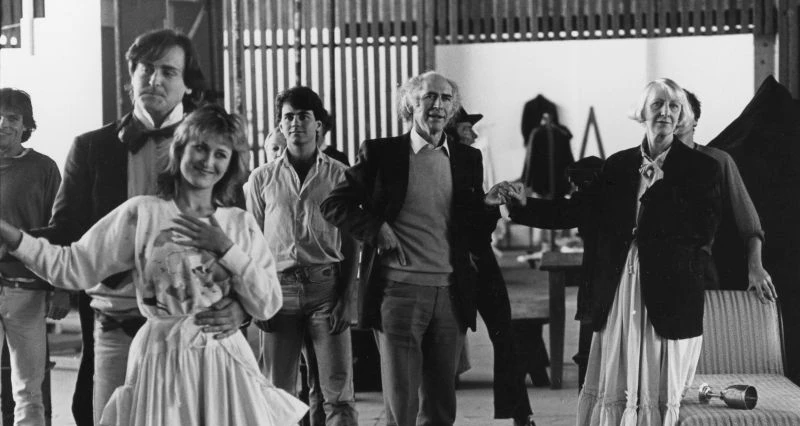
Header Image: The cast of The Life and Adventures of Nicholas Nickleby, pts 1, 2, 1983 – Sydney Theatre Company and The Australian Opera, in association with MLC Theatre Royal Company. Rehearsals took place in the unrenovated Wharf 4/5. Photo: Brett Hilder