
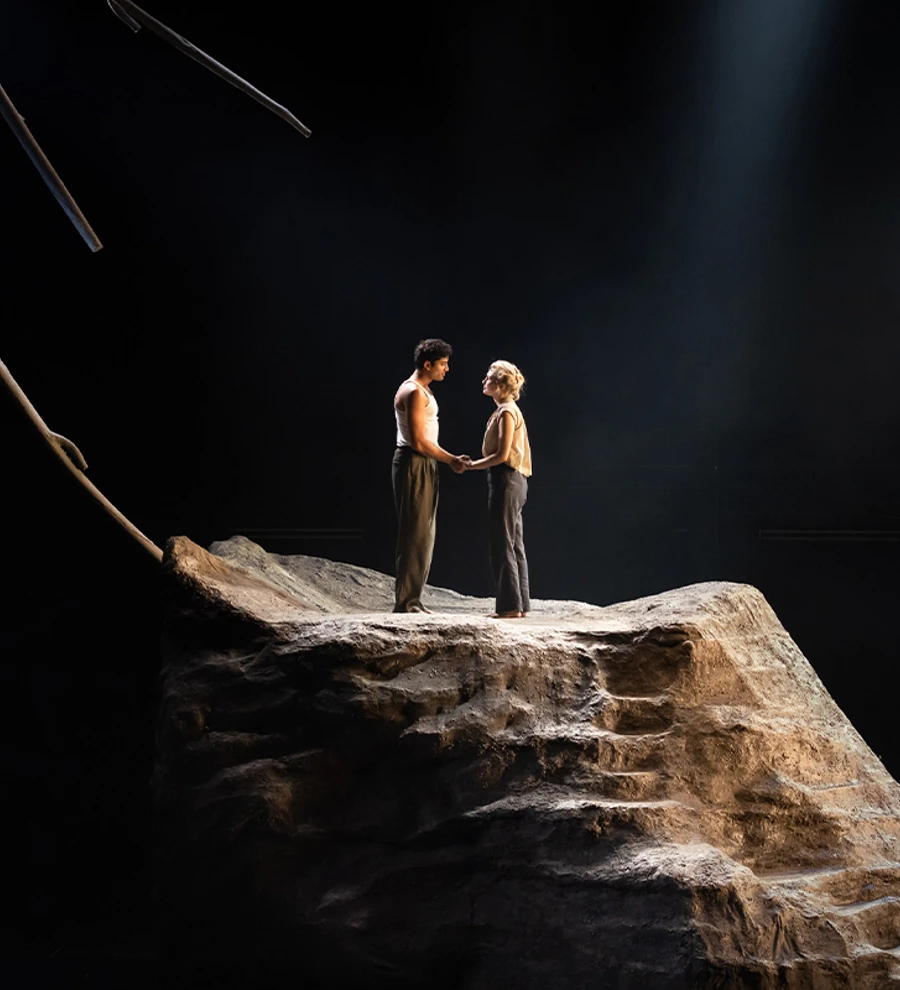
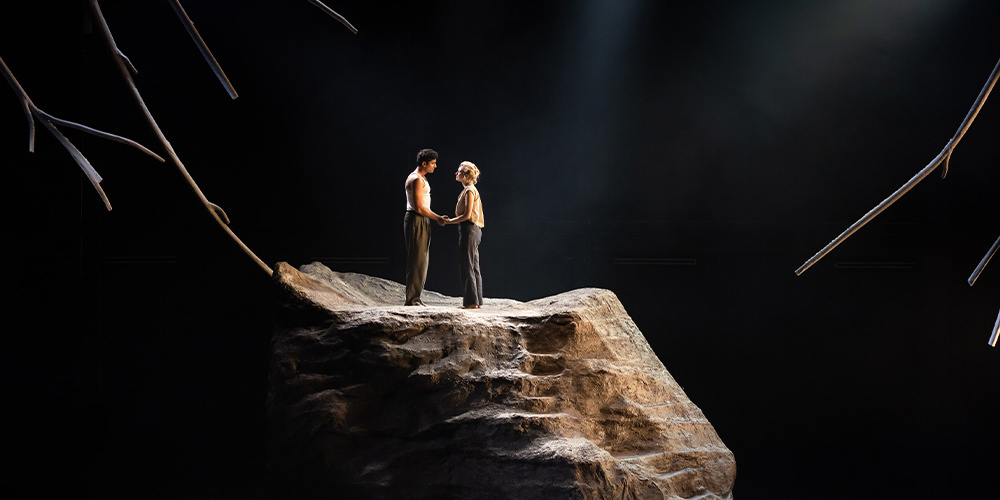
"It's being referred to as Dwayne,'" says STC’s Set Construction Manager, Boaz Shemesh of the centrepiece of Kip Williams' new production of William Shakespeare’s The Tempest: a finely detailed, extremely lifelike 3½ metre rock.
Constructing this impressive set was a mammoth 5-week process that involved many of the extraordinarily talented artists and craftspeople that work here at The Wharf.
Ahead of Dwayne’s debut on opening night, Boaz takes us through the process and the people involved.
THE REFERENCE ROCK AND PLANNING THE BUILD
"The original rock was presented to us in the preliminary design presentation. That was a rock that Jacob [Nash, Set Designer] had found. And it provided the start to the overall shape. Emily [Adinolfi, Props Manager] worked with Jake to sculpt this, which has become the actual rock."
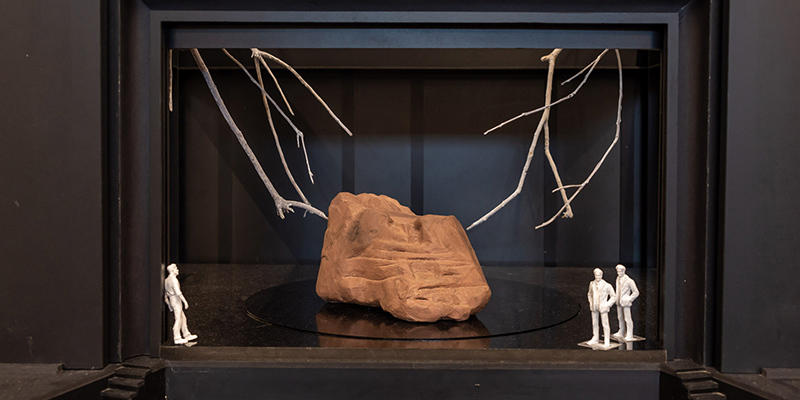
The Tempest set design by Jacob Nash. Photo by Daniel Boud
“From this, we were able to take a 3D scan and turn it into an object that Andy [Powell], our draftsman, was able to slice up and take profiles from, and then you'll see on the inside of the rock, were able to create plywood formers, that we CNC'd [Computerized Numerical Control – a computer-controlled cutting process] to replicate these exact profiles.”
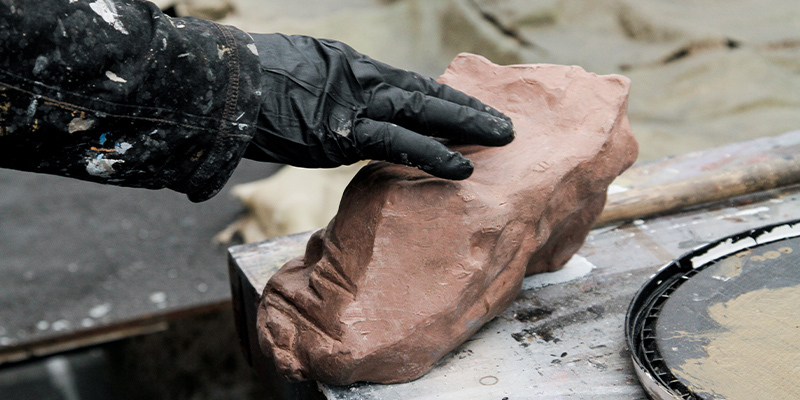
Photo by Joanna Shuen
THE STRUCTURE
"We knew that the cast had to access the inside of the rock, so we had to start with a clear space inside to give them as much room as possible. Then we worked out from there."
The rock is like a giant a papier-mâché project, but made from layers of Wagner cotton drop sheets rather than paper.
"We engineered it with the steel structure and ply formers. And the chicken wire came in as part of Neil [Mallard, Scenic Art Manager]'s scenic process from his sampling."
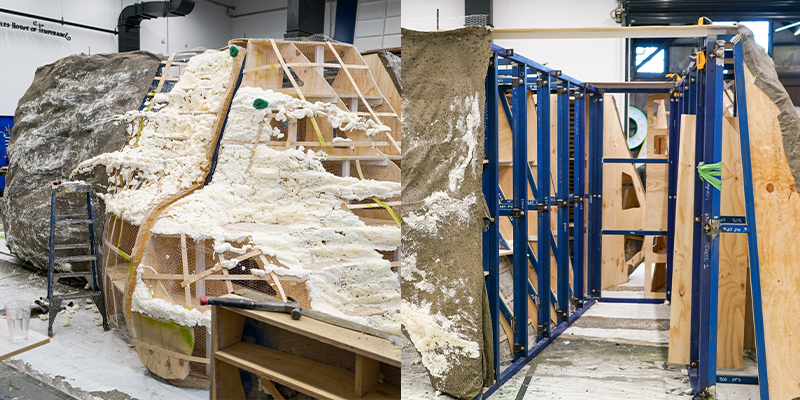
Photo by Richard Cox
"We knew that the back end of this construction process for Neil was going to be really tight, so he came up with a way to pre-paint material that we could layer onto the rock once we formed it."
"The material was glued on to the chicken wire with some expanding foam sandwiched in to give it some shape. And then a membrane was painted onto that with some texture."
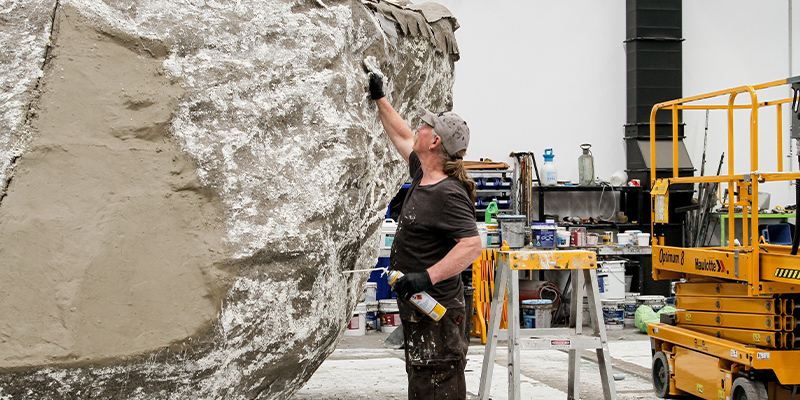
Ron Thiessen, Deputy Head of Scenic Art, adds detail and texture to the rock. Photo by Joanna Shuen
ROCK CLIMBING HOLDS
As the cast will be climbing up and down the rock during the show, the team had to build in mechanisms that would allow them to do so safely.
"We used rock climbing holds, which I've since found out are called 'jugs'. Joe Fletcher, the Production Manager, is an avid indoor rock climber, so there are some of those attached to the real rock."
The Scenic Art team have done such a good job at camouflaging the jugs against the rock, they are all but invisible. You will have to look very closely to spot them!
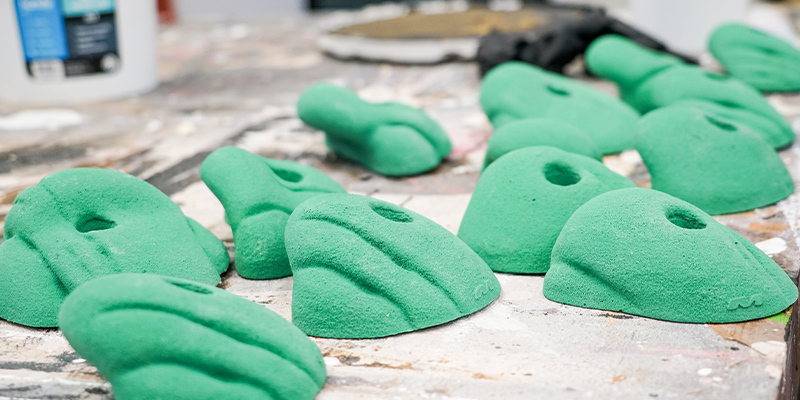
Photo by Richard Cox
REHEARSAL ROCK
Boaz and his team had to build two rocks: the final set that will be on stage, and a rehearsal rock for the cast to practise on during rehearsals.
The rehearsal rock influenced changes in the shape of the set that made it to the stage: “It's evolved a little bit from that rehearsal rock. With cast on it, the practicalities have changed a little bit in terms of these layers, where the steps have to be more accessible.”
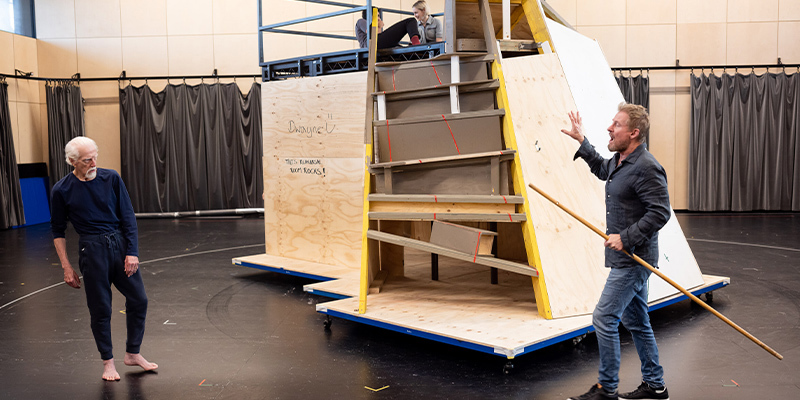
Actors Peter Carroll, Shiv Palekar, Claude Scott-Mitchell and Richard Roxburgh in rehearsals for The Tempest. Photo by Daniel Boud
Movement directors Nigel Poulton; Tim Dashwood kept the cast in shape and trained them to navigate the steps and handles with fluidity. "The top platform had a handrail all around it until they were comfortable up there."
MOVING THE ROCK TO THE ROSLYN PACKER THEATRE

STC’s Workshop team. Photo by Joanna Shuen
The final, massive task for the team is to move the rock from STC’s workshop on The Wharf to its ultimate destination on stage at the Roslyn Packer Theatre. This move was factored into the original design: "We tried not to design it in a way that it would weigh more than if it was just an actual rock! But that's always challenging, because the layers just build up."
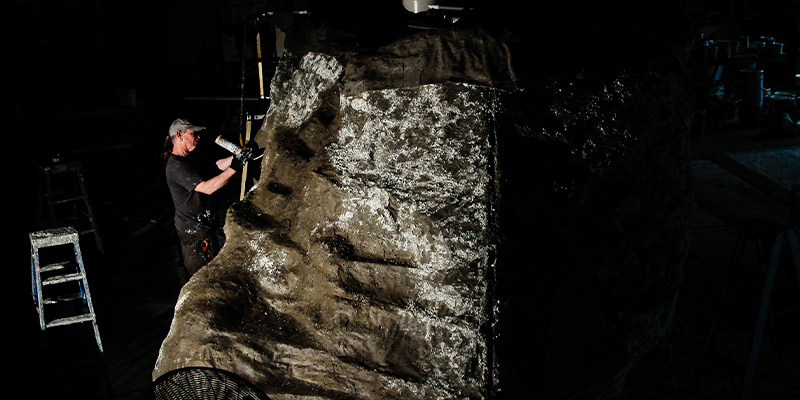
Ron Thiessen, Deputy Head of Scenic Art. Photo by Joanna Shuen
The rock is designed to be broken apart and weighed: “It comes apart in four main pieces, and the top comes apart into another two pieces. We need to know how much it's going to weigh – it'll tell us how many people we need to move it.”
"We put it onto our carriers and it will get forklifted on to a truck and unloaded at the Ros[lyn Packer Theatre], wheeled in, and then get lifted up onto dollies to roll across the revolve and put in place."
ON STAGE
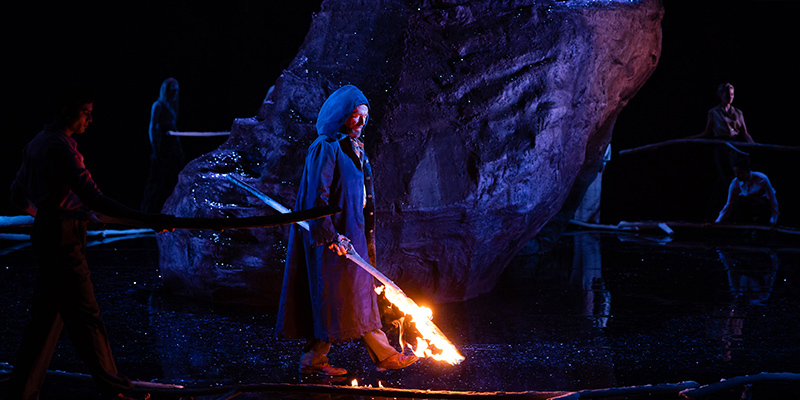
Richard Roxburgh in The Tempest. Photo by Daniel Boud
WHAT HAPPENS TO DWAYNE AFTER THE SHOW FINISHES
"I think Neil has been asking to have it afterwards to put on his property in the bush. Kind of a little bunker. If he can get it there and assemble it, then good luck to him!"
STC is one of the largest employers of arts workers in Australia. If you would like to support us, please consider making a donation online or by contacting the Philanthropy team on (02) 9250 1976.