
Learn more about Chinese Australian history, from its very beginnings to today – written and collated by Charlie Chow, with the support of Museum of Chinese in Australia, to mark the Sydney premiere of The Poison of Polygamy.
Chinese Trade with First Nations
Trade links between China and the Australian continent existed long before the arrival of European colonists in 1788. For example, historical records indicate that the First Peoples of Northern Australia engaged in the trade of trepang (sea cucumbers) with fishermen from Makassar – a city on the island of Sulawesi – from, at least, 1700. Makassan fishermen then traded that trepang with customers in China. Some researchers think that, by the nineteenth century, up to a quarter of the total Chinese trepang market was supplied from catches traded by the First Peoples of Northern Australia.
1818
Colonial Australia’s first Chinese immigrant lands in Port Jackson
Born in Canton (present day Guangzhou), Mak Sai Ying (麥世英), later known as John Shying, was the first recorded Chinese free settler to arrive in Australia. He landed at the end of February 1818 on the Laurel, settling in Sydney. A carpenter, he worked for pastoralist Elizabeth MacArthur at Elizabeth Farm and is said to have made her a linen press in 1824. Shying became the first Chinese landowner and publican in Australia, although he later lost his claim to the land due to laws barring foreigners from land ownership. Shying visited Canton from 1832 – 37 before returning to Australia permanently before the First Opium War.
1839 – 42
The First Opium War breaks out in Canton
In the nineteenth century, European demand made Chinese goods highly sought-after commodities. However, China required silver as payment, rather than goods, which quickly drained the British coffers. In response, the British illegally introduced opium into China, quickly leading to widespread addiction and social issues. Opium became the dominant form of currency, leading to British economic domination. The Qing Dynasty countered by introducing regulations and destroying opium crates which prompted violent warfare, ultimately concluding with a British victory and the colonisation of Hong Kong (1842 – 1997).
1851
The Gold Rush begins in New South Wales
Following his return from a Gold Rush in California, Edward Hargraves discovered gold near Orange, New South Wales, in early 1851. Word spread fast, and thousands of gold prospectors flocked to rural New South Wales, seeking wealth and opportunity.
Victoria also experienced an influx of immigrants later that year, the most popular towns being Ballarat and Bendigo. The racially diverse gold miners originated from all over the world, with Chinese miners being the largest non-European group, referring to Victoria as New Gold Mountain (新金山). The rush did not end until the start of the twentieth century.
1851 – 56
Chinese migration increases
From 1851 – 56, an estimated 50,000 Chinese migrants entered the colonies that became Australia.
Many of those who did not work the goldfields started market gardens. They dominated agricultural markets and formed enclaves – now known as Chinatowns – in major cities. Australia’s first Chinatown sprang up in Sydney near Haymarket, where the Chinese market gardeners plied their produce.
The mass migration caused xenophobia-induced panic, and as a result, governments imposed taxes and regulations, most notably the Victorian Poll tax of 1855, which restricted the number of Chinese migrants entering the colony.
1854
Australia’s first Chinese restaurant is founded in Bakery Hill, Ballarat
Cantonese immigrant John Alloo (Chin Thum Lok) founded Australia’s first Chinese ‘cookshop’ along the Eureka Lead in the Victorian goldfields. Although the Western-centric menu did not have now-classic dishes like sweet and sour pork, Alloo paved the way for thousands of Chinese restaurants today. Many of the cooks who followed served European and Chinese food, introducing one of Australia’s most beloved ethnic cuisines.
1856 – 60
The Second Opium War, Treaty of Tientsin, Convention of Peking in Canton
The Second Opium War continued the conflict between the Qing Dynasty and the British, aided by the French and Russian military. The Qing Dynasty suffered significant losses and conceded, signing the Treaty of Tientsin, ratified by the Convention of Peking, and legalising the opium trade.
1860 – 61
Lambing Flat Riots
Following ongoing Anti-Chinese sentiment, the Lambing Flat Riots were a series of protests against Chinese gold miners in the Burrangong region of New South Wales. The most violent riot was in June 1861, when more than 2000 European and North American gold miners attacked Chinese miners.
1879
The Chinese Question in Australia
Written by Lowe Kong Meng, Cheok Hong Cheong, and Louis Ah Mouy, ‘The Chinese Question in Australia’ was a pamphlet distributed to encourage opposition to the Immigration Exclusion Act on account of its negative impacts on the Chinese Australian community. The three Cantonese men who wrote and edited the pamphlet were prominent leaders within Victorian Chinese communities, working as merchants and missionaries.
1898
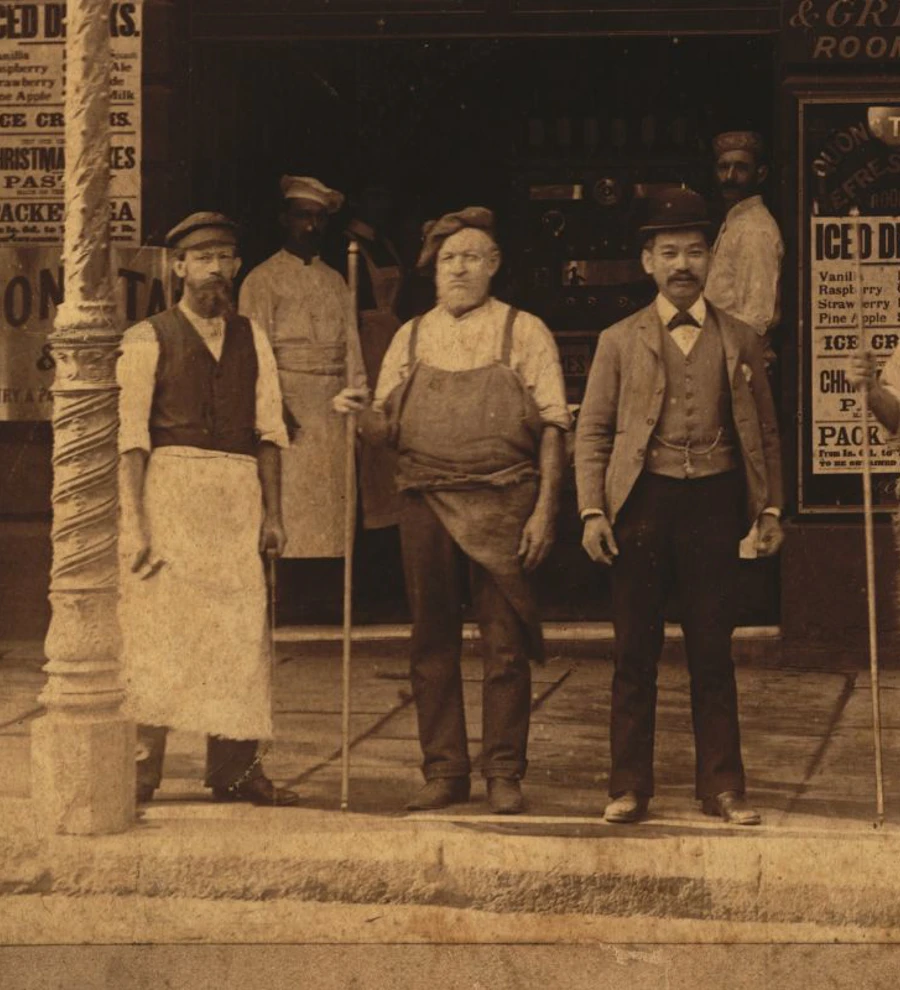
Moy Quong Tart’s Elite Hall opens
Moy Quong Tart (梅光達) was a high-profile Chinese businessman and wealthy philanthropist who liaised with Chinese and Australian communities amid racial tensions. Celebrated in Australian and Chinese circles, he was granted titles by the Qing Emperor and petitioned the New South Wales colonial government to ban opium use. His successes in opening teahouses led to his grandest: the Elite Hall, located in the Queen Victoria Building in Sydney, which people of diverse racial and socioeconomic backgrounds frequented.
1901
Establishment of the White Australia Policy
Racism leading up to Australia’s federation led to restrictions on migrants, specifically Asian people and Pacific Islanders. Introduced to combat the influx of non-British migrants entering Australia, the White Australia Policy required entrants to Australia to sit a dictation test at the discretion of an immigration officer, who could choose what language the test was conducted in regardless of what language the entrant understood. Australian-born Chinese citizens could apply for exceptions to the test; those who did not gain an exemption had to sit it, with many failing to regain access to their place of birth.
1909 – 10
The Poison of Polygamy is published
The Poison of Polygamy was the first Australian novel written by a member of the Chinese diaspora, published in serial form between June 1909 and December 1910 in the Chinese language newspaper the Chinese Times.
Written by Wong Shee Ping (黃樹屏), it was rediscovered by Mei-fen Kuo and translated by Ely Finch in 2019. Pictured next to each instalment was an image of a boy with a mirror next to words 社會鏡, which translates as ‘The Social Mirror’. The novel reflects on diasporic perspectives on racial tensions in Australia and the imminent fall of the Qing Dynasty in 1911.
1934
An exception to the White Australia Policy
Restaurants were granted a vital exception to the White Australia Policy, allowing restauranteurs to bring male family members to Australia. Chinese people in Australia thrived, finding their space in the service industries of Australian society.
1973
End of White Australia Policy
Although the White Australia Policy was relaxed in 1957 in repopulation efforts following the Second World War, it was not until 1973 that the Whitlam Government abolished it in full.
1980
Paifang are erected
Two traditional Chinese gateways, or paifang, were erected at the ends of Dixon Street in the heart of Sydney’s Chinatown to celebrate the end of the White Australia Policy. The paifang represent the amity between Australia and China and stand as a testament to the ongoing contributions of Chinese Australians. While many Chinese people have moved out of Chinatown and into the suburbs, it remains a hub of multiculturalism and is home to night markets every Friday.
1992
Haymarket Library opens
On July 1 1992, The Alderman of Sydney, Lord Mayor Frank Sartor officially unveiled the bronze plaque on the multicultural Haymarket Library, aptly housed in the Commercial Bank branch used by Chinese market gardeners at 744 George Street from 1875 – 1925. The Library’s collection was groundbreaking, holding publications in English, Chinese, Indonesian, Japanese, Korean, Thai and Vietnamese.
2020
City of Sydney leases the former Haymarket Library to the Museum of Chinese in Australia
Following the Haymarket Library’s move to a new building in 2019, City of Sydney leased the former Haymarket Library building to the Museum of Chinese in Australia (MOCA). The museum’s location continues the historic building’s links with Sydney’s Chinese diasporic community, creating a new home for Chinese Australian stories of the past, present and future.
By Charlie Chow
Born and raised in Hong Kong and currently living in Sydney, Charlie Chow is a history honours student at the University of Sydney. Her honours thesis is a culinary approach to the history of Cantonese Migration in the US and Australia.
Thank you to Museum of Chinese in Australia for their support in producing this timeline.
Header image:
The Elite Hall - Moy Quong Tart (4th from left)
Item 06/000026, Tart-McEvoy Papers, Society of Australian Genealogists Archival Collection.