
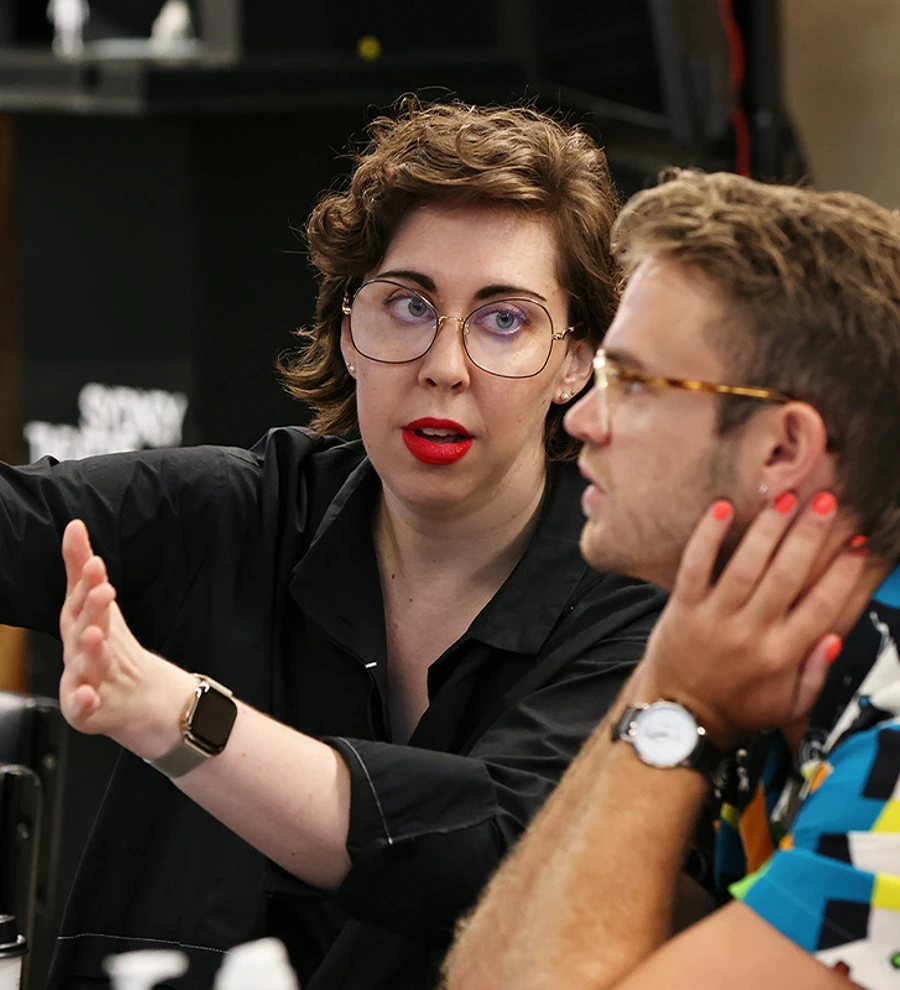
Tell us about the design process for Julia, where did you begin with this production?
R: The process started as a conversation with Director, Sarah Goodes. We spoke about when Julia Gillard made that now famous speech and how that moment became viral around the world. We asked ourselves about what it meant at the time and looked at what that moment in time has now become.
“There was a monumentality and pressure that Sarah was wanting for the space.”
S: Normally ideas for music composition start at script stage but with Julia I was responding as much to the production design ideas from Sarah and Renée. My score really evolved watching rehearsal and was also influenced by Susie and Alex’s design thoughts.
What sort of research did you do for this production? What were some of your key references?
R: There was a monumentality and pressure that Sarah was wanting for the space. One of the starting points was looking at the architecture of Parliament House as well as its colouring and interior. Obviously reading about and watching Gillard’s speech in full was another starting point.
S: Probably the only research I did outside of Julia Gillard’s story was looking into her family’s Welsh heritage which is a significant part of the play. I tend to work more instinctively on the score rather than doing research.
“Video and lighting provide focus and assist with the flow of the storytelling.”
Julia investigates real-life events but from a psychological or imaginative perspective. From a design point of view, how do you go about mixing the real world with the theatrical space?
R: We have discovered in rehearsals that the character of Julia played by Justine is not just Julia Gillard, she’s also a narrator, an observer, the representation of the everywoman. In turn Jessica’s character floats between; a young Julia, a reflection, an aid, and a representation of the next generation. I’ve referenced a certain colour palette that was initially inspired by the colours Julia Gillard wore the day she made the famous ‘misogyny speech’. However, the final costumes have really developed beyond this. In this production we explore the public and the private sides of the character of Julia. Using reflection, refraction and isolating the stage into separate performance areas, the carpeted square serves as a public arena, at other times it’s a space that represents her inner thoughts. The front and side edges of the space serve more as a memory space. All elements of the Production work together very much hand in hand. Video and lighting provide focus and assist with the flow of the storytelling. The sonic world of the play is also incredibly important, bringing tension, suspense as well as emotion. Costume helps flesh out the character visually. All elements are equally important in a piece like this and are all key in supporting the story and the cast’s performance.
You've both worked with Sarah Goodes on a lot of productions. How does Julia relate to and expand on the work you and Sarah have done in the past?
R: I think we’ve developed a kind of design/aesthetic short-hand when it comes to working on shows together, particularly new works. Where a design exists, but playing in the rehearsal room is all part of discoveringthe piece. This show feels like a culmination of process, thoughts and ideas that certainly wouldn’t have landed on stage like this if we hadn’t been long-time collaborators.
“This show feels like a culmination of process, thoughts and ideas”
S: I think this is my tenth production with Sarah. Those shows have been pretty eclectic in style but I feel during this journey we’ve developed a great understanding of how we work together. There is probably a style of score and design we’ve leant towards for a number
of these shows but ultimately I think we’ve come to really trust each other’s ideas which is paramount when the pressure is on.
Without giving away any spoilers, are there any special moments in the play, design-wise, that audiences should look out for?
S: There may or may not be an easter egg for the Welsh speakers in the audience.