
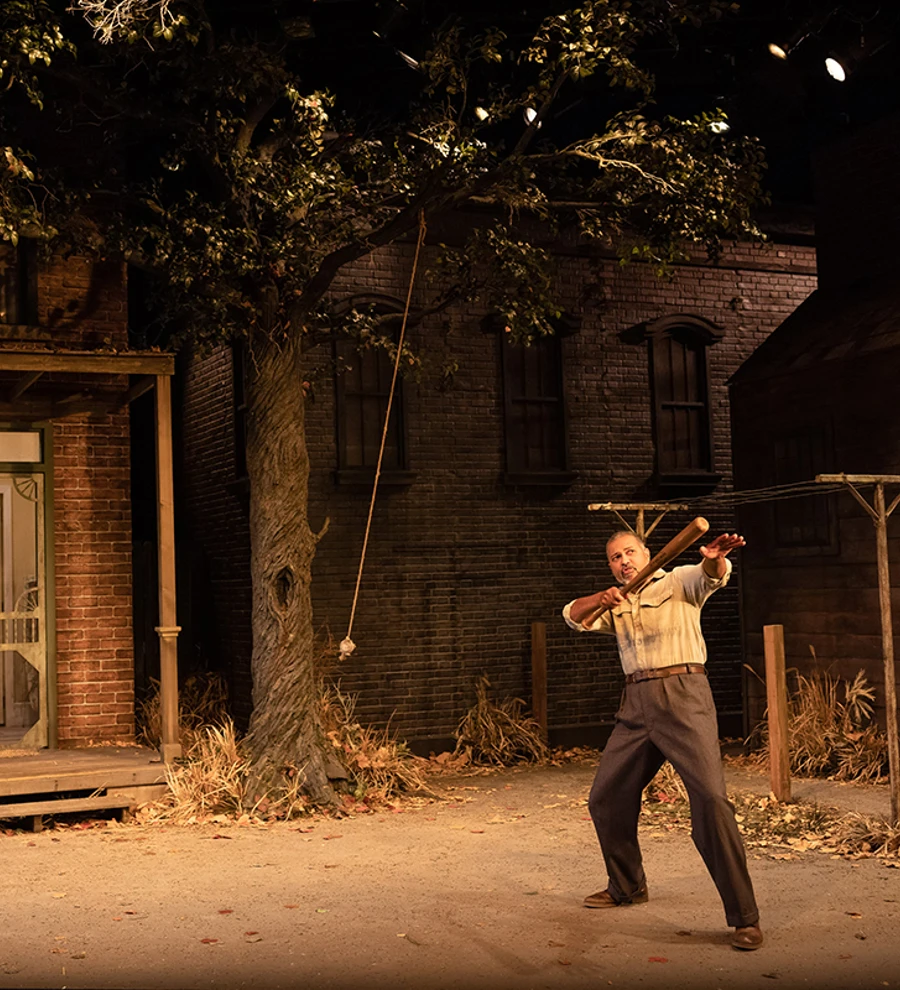
To accompany STC’s production of Fences – the first-ever production of this play in Australia – Community Engagement Consultant Cessalee Stovall interviewed two actors and expert interpreters of August Wilson’s work, Lester Purry and Bryan Bentley, to give us a better understanding of the context and historical importance of this amazing artist.
When did you first become aware of August Wilson’s work?
Lester Purry: I first became aware of August Wilson's work when I saw Ma Rainey's Black Bottom at Penumbra Theater, the theatre that August got his start at. And I was so blown away by that production. I worked three and a half years before I was finally able to get cast as Cory in Fences and worked there well enough and did enough August Wilson to become a company member and actually got to meet him and talk with him a handful of times.
Bryant Bentley: I remember when I first started acting at a community theatre, they were performing Fences actually, but I wasn't focused on the writer at that time. I was just trying to build a resume and I was trying to audition for any and everything. But I remember that I auditioned for the character Gabriel. Then 2002 came along and I ended up working at Indiana Repertory Theater and another gentleman, David Alan Anderson, started introducing me to who August Wilson was and gave me some history about him. And soon afterward, Wilson passed away, it was 2005 I believe. Right after he passed away, my first performance in one of August’s shows was in 2007, I got cast as Boy Willie in The Piano Lesson and the rest was history: my goal after that was to seek every play that August Wilson had written. I ended up connecting with a director out of Pittsburgh who was a mentee of August Wilson, Mark Clayton Southers, and he introduced me to a lot of Wilson’s work out there and the history of Pittsburgh.
How many of Wilson’s plays have you appeared in?
BB: Right now I'm at my seventh production, seven [of The American Century Cycle] out of 10. So three more to go.
LP: I've done six of the 10. I've done Fences four times, Two Trains Running three times. And the ones I have yet to go: Radio Golf, Gem of the Ocean, Ma Rainey's Black Bottom and Joe Turner's Come and Gone.
What does Wilson’s work mean for you?
LP: For me, it's the truth of the Black experience in America. The writing is so clear and so good that you can't help but tell the truth [when you’re performing it]. I think any actor that has performed Wilson’s work says, “I know these people”. This is my uncle, this is the guy down the street. Well, what happens then is that creates the misperception that the work is easy to perform, because you're familiar with these people, because they're so real and they're so palpable. But it's a difficult thing to do because they are real people and you have to be honest with yourself. You have to be honest with August’s writing and you have to have stamina. And these are stories that defy stereotypes and it brings a truth to the American canon that I think had not been really seen before August Wilson.
BB: I definitely agree with everything Lester said and want to mention, his works are still relevant to what's happening today. It feels like August was way ahead of his time. And at the same time, he’s also shown us that not too much has changed. I'm in Seven Guitars at the moment and even some of the language that’s in that script, the conversations that we're having: that character Floyd is saying, “I got arrested for not having no money in my pocket. They just threw me in jail”. And then you have Red Carter saying, “they arrested me for having too much money because they said I must have stole it somewhere”. What you get out of the play is that there's still police profiling. It still hasn't been changed because of the colour of your skin.
And I see so much of my family in these. I grew up in these homes… the stories that my grandfather would tell me or how he would tell me are similar to how August writes when his characters are telling stories to each other. So I can hear my grandfather's voice sometimes and I can hear my uncle's voice and it does something to me. I love the fact that these shows are for us, we can claim these and there's a lot of truth that we have in our personal lives that you can still bring out and tell in these stories, when you tell them honestly.
What do you think about the fact that STC’s production of Fences is the first time it's being performed in Australia?
LP: The last time I did Fences, I played Troy and I had mostly men (but some women) from different cultures, different backgrounds, different ethnicities come up to me… There was a man, he had to be in his mid to late eighties, he stayed sitting in the front row and he asked to see me. And when I approached he was crying so hard he couldn't stand up man. And he said, "You were my father and he was a white man." I had a young Asian man come up to me crying, "You were my father", a young Latino man, "You were my father." So anyone who has experienced an oppressive parent, especially a father, will get this. Any culture that has experienced oppression will get this because this is what Troy is facing, this is what he's fighting.
And oppression is universal. American oppression is somewhat different, but oppression affects the heart. And when people see that heart’s beat acted out on stage, they will immediately connect to it and relate to it. So it doesn't matter what country, it doesn't matter the ethnicity, it doesn't matter the socioeconomic group, it doesn't matter the age, they will connect with it.
BB: I just say, Australia look out because I'm telling you: if the story is told right, this won’t be the last time you see an August Wilson there. If you have a good group of actors that can tell this story honestly, then I would say Australia is in for a treat because I believe that anyone can relate to Fences. Anyone can relate to Troy Maxson. There are going to be moments in the play that will hit them. Like, "Man, I remember this conversation with my father. I remember my father getting on me about this or getting him."
I believe there'll be more to come with that and the exposure of his work is becoming even more relevant, even from Denzel Washington putting it out and exposing the work [in the recent film adaptation of Fences] to a bigger market. So I believe everyone's going to know August Wilson pretty soon if they don't know now already.
August Wilson's Fences is on stage now at Wharf 1 Theatre until 6 May 2023.