
“Facts have their importance – but that is where the biography comes to grief. The biographer cannot extract the atom. He gives us the husk.”
– Virginia Woolf
As Joanna Murray-Smith observes in her notes, there is very little to be found in all the records and biographies of Julia Gillard’s inner life. So all we can do in this production is attempt to capture the essence of her, the atom. And what better place to crack open these husks and fill them with our imaginations than the theatre – the home for imagination.
This is the third time I have directed a new play by Joanna Murray-Smith – the last one at STC was the world premiere of Switzerland, back in 2014. When Kip called to propose this project, I didn’t think twice. New work is not for the faint-hearted. As someone once observed when you mount a classic, all you have to do is move the furniture in and spend rehearsals deciding where everything should go but with new work you have to build the house first. However difficult this process is, it is also thrilling and exciting with a writer like Jo who is incredibly responsive to rehearsal rooms and the offers and shifts they can throw up.
Julia was ridiculed and imitated for her entire political term, so my first instinct with the piece was that I wasn’t interested in exploring a typical impersonation. Instead, I was interested in playing with form. For many years I have watched Justine Clarke work on the stage and dreamed of working with her. Justine dives deep, bringing truth and heart to all her work. She is like a cormorant bird – she can fly high but she can also dive deep for the fish! We were all delighted when she accepted the challenge.
My early conversations with Justine circled around the generational intersection that Julia’s speech activated. Justine and I spoke a lot about how, as women of a certain age, we felt slightly guilty for not having spoken up more when Julia was being treated as she was during her term as PM. It felt right to not meet Julia fully-formed, that we meet Justine as the narrator (an actor embodying every woman) who slowly embodies the imagined version of Julia and finally transforms into her entirely. We wanted to amplify the universal in the piece: what it means to look back on a life and examine your choices and the times in which you were born and the tide that carries you through. Justine also spoke of how she imagined mothers and daughters might come to the show and the conversation between generations that it might ignite.
I started to think of the waves of feminism and why they are called waves and why they occur in waves. One generation ploughs the soil and then next reaps the seeds. I had a strong sense of a younger woman waiting silently, willing and waiting for Julia to make astand – to make the speech that (it could be argued) opened the gates for the movement that followed. Julia’s ‘misogyny speech’ is a brilliant example of the power of words – to open doors for us as individuals as well as collectives is endlessly fascinating – how social movements, like schools of fish, can take form and suddenly change direction as one organism.
“Societies are shaped not by what is happening on the surface but by the great tidal movements underneath.”
– The Making of Julia Gillard by Jacqueline Kent
So the decision to include Jessica Bentley in the production as a fluid presence on stage – at times the younger Julia, at times her conscience, at times the future generations. – was made. The witness and watcher – our younger selves – what we sacrifice on our way through life pursuing our dreams or fighting our fights – who we become in the process and what we leave behind.
Designer Renée Mulder and Composer & Sound Designer Steve Francis and I first worked together back in 2011 on Hilary Bell’s play The Splinter. We have since worked on many projects . Both are incredible artists and theatre-makers and together with the extraordinarily talented Alexander Berlage as Lighting Designer and Susie Henderson as Video Designer, along with Charley Sanders as the Assistant Director and the brilliant Jennifer White as Voice Coach, this has been collaborative theatre at its most exhilarating.
Reneé and I used, as a springboard, the work of female video artists Pipilotti Rist and Angelica Mesiti and photographer Alex Prager. Susie Henderson pointed us towards Mesiti’s work whose piece Assembly was presented as part of the Venice Biennale. Her work really struck a chord for us about how we wanted to approach this piece – the power of space, voice, and youth.
Steve Francis and his composition is the texture we needed – we talked a lot about soil, growth, the earth, light, and transformation – how even moments and events can transform in the hands of the next generation and listened a lot to Carolyn Shaw’s album Let the Soil Play its Simple Part.
A huge thank you to Dr Rebecca Sheehan, Ruth Little, Alice Osbourne, and the Stage Management and Production team at STC, and to STC and Canberra Theatre Centre for inviting us all to work on this new Australian work.
Julia is on stage now at the Drama Theatre, Sydney Opera House.
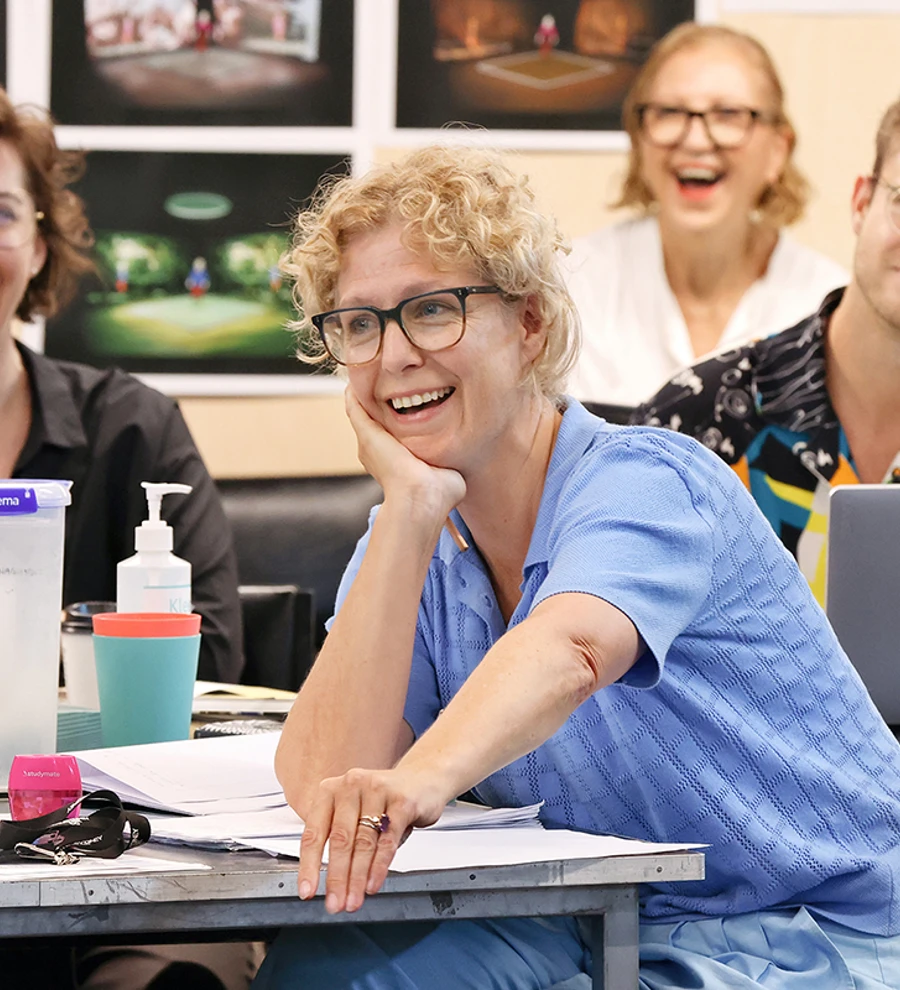
Image: Sarah Goodes in the Julia rehearsal room with Renée Mulder, Joanna Murray-Smith and Alexander Berlage in the background. Photo: Image: Prudence Upton.