
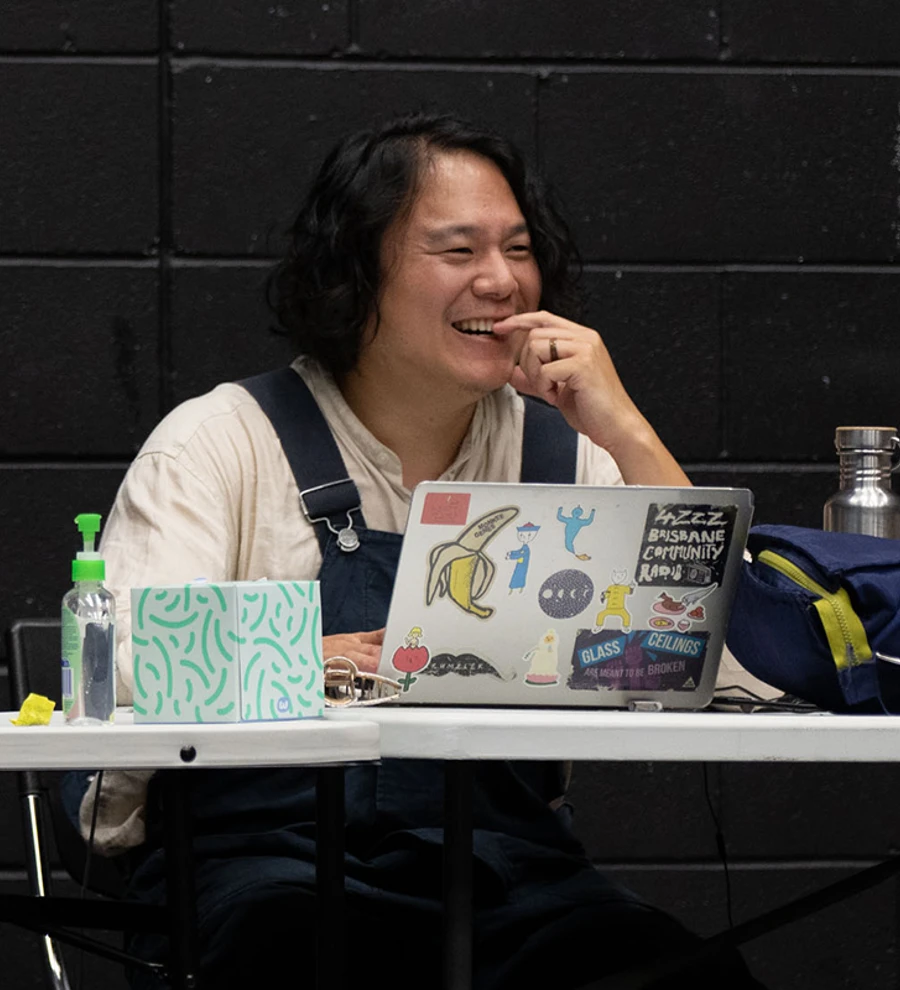
Composer and musician Matt Hsu, who practices under the moniker Matt Hsu’s Obscure Orchestra, sat down with us to discuss his work on our premier production of The Poison of Polygamy (co-produced with La Boite Theatre). Plus listen to his curated playlist for the production.
Who are you? And what is your connection to the production The Poison of Polygamy?
Hi! I’m Matt Hsu, a punk-trained composer and Taiwanese-Australian who loves ramen and forest hikes.
Matt Hsu’s Obscure Orchestra is both my solo moniker, and the 22-piece alt-orchestra that I lead. It started off as an exhaust valve for my curiosity about sounds and different instruments, and I called the project Obscure Orchestra in jest of it being just me making all this noise, never thinking that I would actually start a full orchestra. It’s grown very fitting for the ‘gnome-core’ experimental ensemble that we’ve become.
A big part of my adolescence was overcoming internalised racism. I tried to be as far from the ‘stereotypical Asian’ student as I could, that caricature of the studious, anti-fun, uncharismatic, party-averse, maths excelling kid, which go hand-in-hand with the ‘model minority’ myth (essentially a by-product of selective immigration policies of the past several decades, blocking entry to working class immigrants and only letting through the professional class, leading that whole 'Asians are all doctors and pharmacists’ thing… mini history!). Part of my raging against that imagined ‘boring Asian’ trope was joining metal and punk bands. Music was my passion and my tool of escape from clichéd social expectations based on race.
Interestingly, that same tool of music also led me back to acceptance and celebration of my Asian-ness, a nuanced understanding of being a person of colour, not generated by Western-centric narratives and stereotypes. Being a gigging musician meant I got to meet so many different kinds of people, artists from different ethnicities, expressing their culture though music which blew my mind, and put me on the path of anti-racist activism, and making music that explores and celebrates marginalisation and culture. I think without me realising it, those learnings have set the core foundational ethos of the Obscure Orchestra ensemble, who are made up of BIPOC, First Peoples, disabled, trans, non-binary and queer artists — people with a deep understanding of being on the margins and a shared appreciation of feeling accepted.
I feel like The Poison of Polygamy syncs so nicely with those personal explorations, dispelling the myth of the model minority to show the imperfections, the complexities and variety found within the Asian community, the struggling, working-class, the tradies and schoolteachers, which are all underrepresented in Western media.
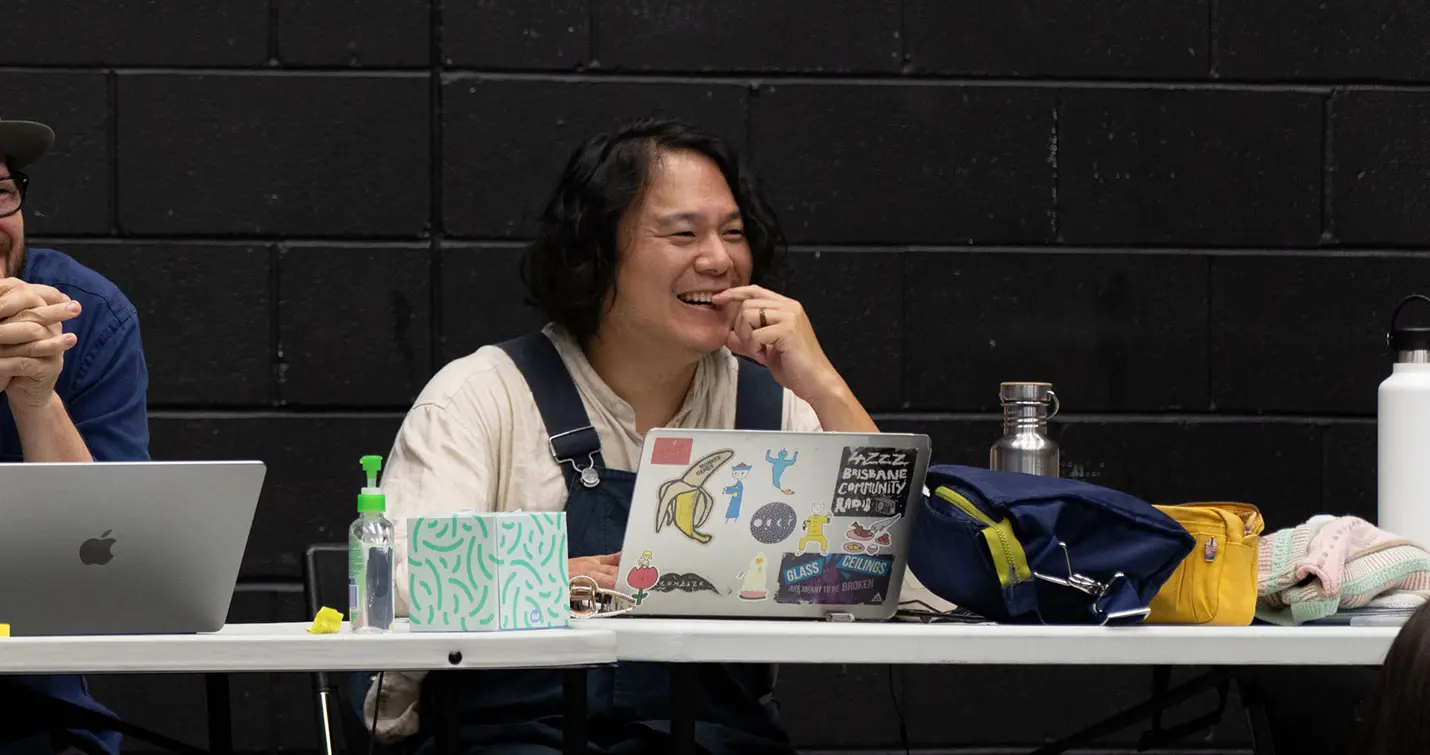 Image: CSQUARE
What were your initial impressions of the play, and how did this develop as you delved deeper into the creative process?
I had a great chat with Director Courtney Stewart before I said yes, when she was in that phase of recruiting people and getting the crack team together – it was like Ocean’s 11! I'm a composer that makes alternative, experimental, sometimes dream-pop, sometimes hip-hop music, who happens to be Asian — rather than a composer who specifically makes ‘Asian-style’ music. So, I wanted to hear why she wanted me for the job. We started chatting about the themes of the show, about acknowledging the long but under-told history of Asian people in Australia, about presenting a different narrative to the clichés and stereotypes about Asian immigrants, about putting that history on a national stage in a nuanced way that showed imperfections, moral dubiousness, and the fact that there isn’t ‘one type’ of Asian Australian. What really sealed the deal for me was when we started speaking about Indigenous sovereignty and the complicity of Asian immigrants in colonisation, how all participants of colonial Australia bear responsibility for the displacement and ongoing inequity that First Nations communities face. When my parents immigrated, the colony/commonwealth are the ones who decide yes or no, and First Nations people aren’t even part of that conversation, and that’s always sat wrong with me. When those ideas were put on the table, it confirmed to me that Courtney and Anchuli Felicia King (the writer) were approaching this with a level of courage and moral shading that I wanted to be part of.
Sound-wise, I’ve been finding such a diversity of textures and sound qualities in a deep array of traditional instruments, learning sounds that perfectly represent certain characters, environments, and feelings. There are drones, bright searing instruments, powerful percussion, extremely emotive strings, horns and woodwinds, all with their unique meanings that have afforded a huge palette that I’ve used for creating mood and tone.
For certain scenes where I wanted to represent the ferocity of women pushing back against layers of oppression, I brought in Naaki Soul, a volcanic powerhouse of primal noise and genius music instinct who has these hardcore/weird/noise vocal free-ness that I wanted. It was a pleasure working with her!
I think I created about 70 distinct pieces or cues, and then combined or stripped away elements of cues together when certain characters met or were put in different situations and environments. All up, there are 220 distinct tracks and loops which were used in the production, not including Guy Webster sounds.
 Image: Prudence Upton
What were your inspirations in composing for this work? Did you engage in any research, and if so, what interesting things did you learn?
Just before composing got underway, I sat down with my parents and asked them about our family history, my ancestors, life in Taiwan and my parents’ decision to move to Australia, then the progression of Sunnybank (Qld) into an Asia-centric suburb. I poured over old family photos, noticing things like my grandparents wearing traditional Taiwanese clothing for wedding photos and then Western clothes in their day to day, then my parents’ 80s disco perms, these continual exchanges of culture have been fascinating to retrace.
As those stories and extra reading percolated and settled in my mind, I started creative dumping, just trying ideas and composing as many different pieces for all kinds of moods, settings and characters. I then went back through the material and matched them to scenes and filled in any gaps, made new combinations, and transformed pieces to fit mood changes.
I’ve idolised Ryuichi Sakamoto, a composer and activist who recently passed away, for a long time, and explored the way he addressed cultural specificity in his film scores, specifically for The Last Emperor. Joe Hisaishi’s Spirited Away and Princess Mononoke soundtracks were also gorgeous touchstones. I also rewatched a bunch of Jet Li’s 90s films like Tai Chi Master and Kung Fu Cult Master, because they’re so fun, but also the incredible music. I also rewatched some Avatar: The Last Airbender and The Legend of Korra to hear how Asian culture was presented through a Western music-rooted lens. I love those shows! Oh, also listened to a bunch of the Taiwanese musician Jay Chou who combines traditional instruments for contemporary pop tastes.
How do you go about composing music for a theatre work?
I think about environment, mood, characters in action, but probably most importantly, whose emotional moment we’re following, because it might not necessarily be the person doing ‘the most’ on stage. I like to create signature sounds for specific characters. I’ll also use any instrument to that end, beyond what would be considered a musical instrument.
For the scenes set in the goldfields of Melbourne, for example, I completely switched the instrument set from traditional Asian instruments, and drew on my folk-punk days with The Mouldy Lovers, and used skiffle homemade instruments, banjo, accordion and tin can instruments, and created pieces that matched the exhaustion of working in the gold fields and the cultural differences to navigate.
Guy, the sound designer, is my partner in crime in this. He’s been a treasure trove of knowledge, experience, and calmness. Working with him to weave together atmospheric sounds with the music, and his depth of theatre know-how, has been a dream.
Over the last decade, I’ve collected musical instruments from around the world, they’re hanging up all around me in my studio, so I have a library of sounds within reach, and for things too rare to find, I dug into some lovely samples.
I used a hulusi, dizi, shakuhachi, clarinet, trumpet, flugelhorn, trombone, a tin can, shamisen, guzheng, bowed vibraphone, mbira, miniature gong, pots and pans, harp, banjo, accordion, furulya, sleigh bells, pots and pans, cello, ocarina, t’rung, gamelan, double bass, musical saw, wind chimes, my cousin’s erhu, a Nord keyboard with a bunch of samples, and a yangqin that was gifted to me from a West End dad.
What role does the soundtrack play in this production?
There are so many amazing creatives working on this, from the direction, the costuming, set design, cast, sound design and lighting, it’s all so sparklingly beautiful. I’m so proud to be among them, each of us supporting each other to build a sense of place, mood, crack the emotional moments, and take audiences to a heightened theatrical representation of historical China and Australia.
What’s it been like working with the team on this show?
It’s really incredible to be part of a team of key creatives that have personal cultural connections to this story and its characters. There’s a level of cultural authenticity, that has been championed by our director Courtney Stewart, that I’m so honoured to be part of.
I’m so honoured to put my creative efforts to something that speaks to Asian-Australian identity, that people will see themselves and their histories represent in, and contribute to the stories of place in the cultural fabric of so-called Australia.
Guy Webster has become my absolute crutch in this — as well as being a sound designer and composer, and we’ve mind-melded so much. He’s always cheerful and optimistic which makes the experience so pleasant, as it should be, and I learn so much from him.
I’ve been trying to my best to share my time between theatre rehearsals and time in my studio composing. It’s really exciting when I get to the rehearsals and test out pieces that I’ve composed with the actor running scenes. It’s incredible watching it come to life. Every one of them is magnetic to watch! Little moments like watching actors sing the melody to ‘Oh Crow’ makes it feel so real, ‘Wow! I’m really composing for a La Boite/STC production!’
Courtney has been absolute dream to work with; her vision, warmth, and enthusiasm is infectious, and moments where she’ll hear music to a scene and exclaim ‘oh, that’s perfect’ feel amazing.
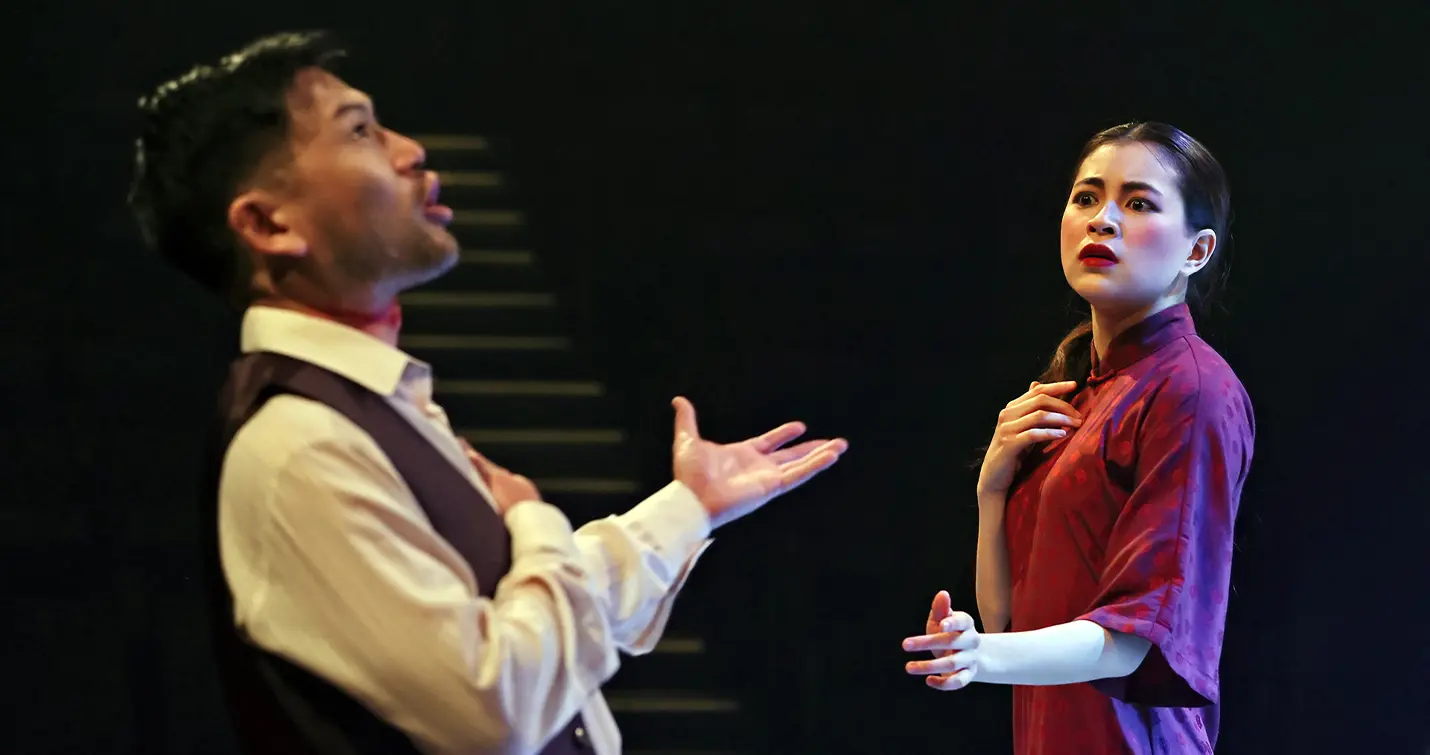 Image: Prudence Upton
The Poison of Polygamy is on stage at The Wharf from 8 Jun.