
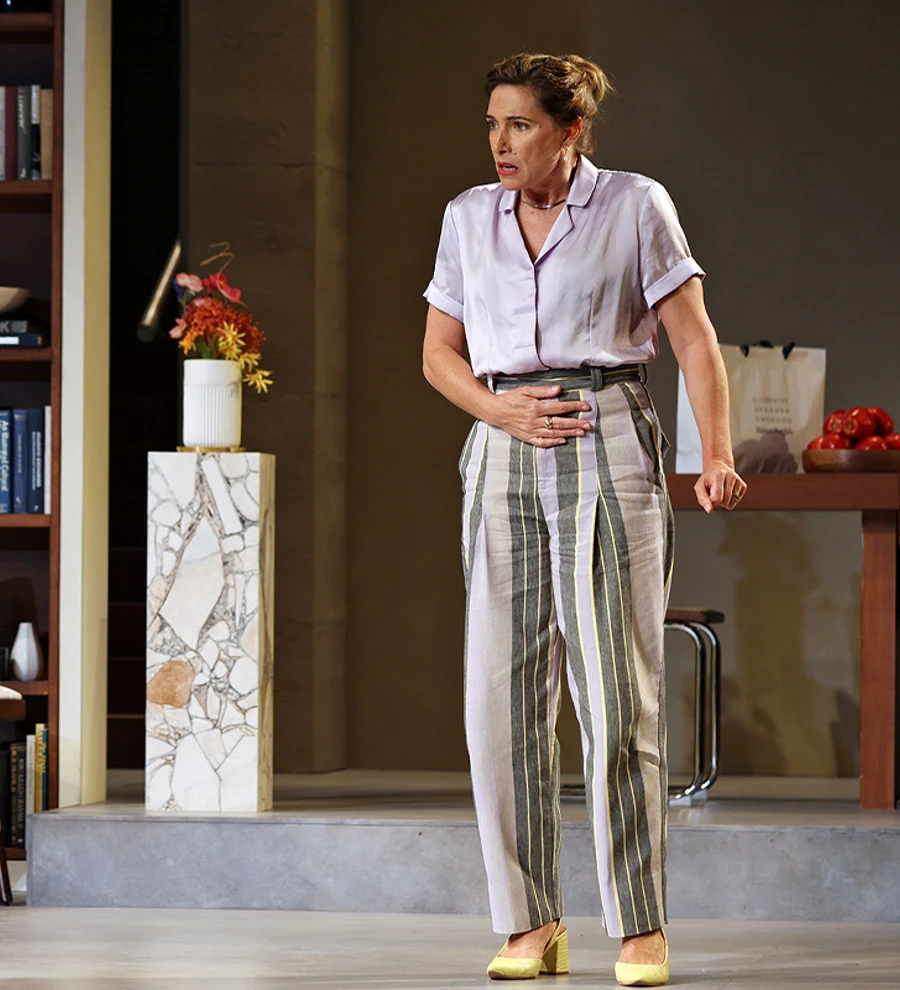
In the published version of The Goat or, Who is Sylvia? Edward Albee adds the subtitle: Notes towards a definition of tragedy.
When we use the word tragedy today, we think of a story with an unhappy ending. For the Greeks, the word ‘tragedy’ did not necessarily imply an unhappy ending. Many of the great tragedies end in restoration of order, reconciliation or forgiveness e.g. in The Eumenides (the last play in The Oresteia cycle) and in Oedipus at Colonus. All that mattered, according to Aristotle, was that the play be lofty and deal with deep emotion and show an action that was plausible.
“When we use the word tragedy today, we think of a story with an unhappy ending.”
According to ancient sources, tragōidíā (meaning ‘goat song’) took its name from the fact that either the winner among the competing tragedians received a goat as a prize, or a goat was sacrificed as part of the festival where the plays were performed. Whichever was true, the goat was an animal sacred to the god and patron of drama, Dionysus.
Aristotle’s Poetics contains the classic definition of Greek tragedy, based largely on the plays of Sophocles, especially Oedipus the King. Aristotle defines tragedy as “a representation of an action, which is serious and completed in a certain period of time.” He also refers to the emotional effect of a tragedy as “the excitement of pity and fear which may trigger the catharsis of such emotions.” Put simply, tragedy is a means of relieving the spectator of powerful stored up emotions.
“The goat was an animal sacred to the god and patron of drama, Dionysus.”
Greek tragedy is fundamentally about violating the laws that give order to human life. But the character at the centre of the tragedy, the protagonist, doesn’t suffer because of a moral flaw but as the result of an error of judgement. Oedipus suffers not because of his quick temper and pride, but because those elements in his character lead him to kill a man in the heat of the moment. This man, it turns out, was his father. In Greek tragedy, those who suffer are always powerful men and women, descended from gods, if not divine themselves.
As a mirror to that suffering, Greek drama used the chorus, a group of singers/dancers commenting on the action of the story and giving voice to the insights the experience gives. Many theorists believe that Greek drama grew from a group ritual with individual performers stepping out of the chorus and enacting moments from mythical stories. But as much as the style of Greek drama changed, the chorus remained as a vital part of the performance.
The climatic event of Greek tragedy, the catastrophe, almost always happens offstage.
This has been explained as a concession to taste and decorum, but more recent commentators have argued that the extraordinary vividness of the speeches which relay these offstage events (called literally ‘messenger speeches’ was intended to intensify the horror by playing on the audience’s imagination rather than by literal presentation.
In his ‘Prologue to the Monk’s Tale’ in The Canterbury Tales, Geoffrey Chaucer describes a medieval view of tragedy. This view is derived from classical sources but it’s also imbued with a Christian sensibility. Tragedies, writes Chaucer, tell the stories of men who stand in great prosperity and then suffer a great fall. This fall is due to the turning of the wheel of fate. It cautions us against placing faith in worldly things instead of God’s will. This fall can happen to anyone who rises to prominence, not just gods, kings and heroes. This view brings tragedy nearer to the lives of real people.
Shakespeare’s tragedies take on the enormous task of dramatising a growing sense of individual personality that characterises the Renaissance. His heroes and heroines are destroyed by a terrible tension between their social selves, as kings, queens, princes, generals and so on, and their own inner drives, their ambition, pride, arrogance, and society is no longer the norm; for Hamlet, Denmark is a prison; for Lear, Britain is a wasteland.
“Tragedies, writes Chaucer, tell the stories of men who stand in great prosperity and then suffer a great fall.”
French Neo-Classical tragedies of the seventeenth century revive the formality of Greek drama with one major exception – there is no chorus. These plays reflect the temporary concern with personal honour rather than universal laws, as the source of the tragic experience. At the end of Racine’s Bérénice, for example, the three main characters part to live alone forever rather than compromise their sense of honour and decorum. And Phèdre shows a woman who, having brought shame on herself and her noble ancestry, takes poison. But these great plays did introduce one important innovation: in place of the chorus there is the role of the confidant, a friend, nurse, tutor or servant to whom the main characters can voice their concerns and who offers advice and comfort in return.
In the eighteenth century, we see the rise of what became known as bourgeois tragedies. These plays depict struggles, not between gods and men or fate and men, but between classes. Their tragic heroes, and often in these plays, heroines, suffer from the strains of a society in rapid change. They usually hold onto ideas of honour and loyalty that are leftovers of an aristocratic age that don’t fit with the rise of a highly urbanised, upwardly mobile, mercantile class.
In the nineteenth century, these dramas reach their peak in the plays of Ibsen. Hedda Gabler, his most barbaric, tragic character, is an aristocrat trapped in a middle-class world.
Class conflict also leads in the nineteenth and twentieth centuries to an almost tragic idea with those at the very bottom of the heap becoming the protagonists of modern tragedy. Buchner’s Woyzeck depicts the first great tragic anti-hero, an abused, inarticulate, uneducated soldier who is driven to murder as much by his environment as by any choice he makes himself. Brecht’s Mother Courage shows another great tragic figure, who through ignorance and powerlessness, helps the destructive machinery of war roll on. And Arthur Miller’s Willy Loman is the great American tragic hero who trades his soul for the promises of the American Dream.
Modern plays have mixed the loftiness of the Greek ideal with a great deal of humour (though there are comic moments in Greek tragedies). This has led to a genre called tragic-comedy, which uses comedy to deal with the horrors of 20th century life. The tramps in Beckett’s Waiting for Godot are tragic figures, even though they don’t do anything except wait for something that never comes. Their attempts to pass the time are pathetically funny and moving, though the play’s overall view of existence is coldly bleak.
It is from all of these great periods of writing in the tragic mode that Albee has created The Goat or, Who is Sylvia? a tragedy for the twenty-first century.
Written by Ursula Dauth, Writing Coordinator, Queensland Theatre Company 2005. This essay was originally published in the program for State Theatre Company South Australia and Belvoir’s 2005 production of Edward Albee’s The Goat or, Who is Sylvia?