While Fences is a moving and universal story of love, shattered dreams and the power of family connection, it is also a precise and beautifully-rendered evocation of a historically significant place and time: that is, Pittsburgh in the 50s and, more specifically, the city’s Hill District, affectionately known as 'the Hill'.
To give our audiences more insight into the world of this spectacular play and the city that forms its settings, Community Engagement Consultant Cessalee Stovall interviewed two people who lived in Pittsburgh during the time the play is set – Bert Ogden and Sara LeGrande. Bert and Sara recounted their memories of Pittsburgh at the time – some difficult, but many full of joy.
Bert Ogden Senior was born in 1938, into a big family. “I'm one of seven children, third eldest,” said Mr Ogden. “My dad was an only child. My mom was the second of 13.”
“[My siblings and I] were born here in Pennsylvania, but in a town Waynesburg right outside of Pittsburgh, about 50 miles. My dad moved for the same reason as most African Americans were coming into Pittsburgh, because of the attraction of better jobs and a better life.”
Starting in the late nineteenth century with the creation of the Carnegie Steel Company, Pittsburgh was one of the US’s major industrial centres during the first half of the twentieth century. High demand for unskilled labour made Pittsburgh a hub for people seeking their own version of the American Dream. Between 1900 and 1940, the promise of opportunity also made Pittsburgh a key destination for the Great Migration. The Great Migration was an enormous relocation of approximately six million African American people, motivated by a desire to escape the segregation and racialised violence of the Jim Crow era, from the southern states of the US up into the Midwest and the northeastern states.
Sara LeGrande, born in Pittsburgh in 1941, says that her family moved to Pittsburgh during this period. “My father was eight [when he moved to Pittsburgh],” LeGrande said. “His oldest brother moved during that whole migration. And I think it's because of the steel mills and all Black folks moved up there because they needed workers up there.”
Although Fences is set entirely in the Maxson family’s front yard, Wilson’s deft and illustrative dialogue paints a thriving and close-knit community that surrounds the family. Bert Ogden grew up in the projects – an American term from public housing – in Pittsburgh at a similar time to the Maxson boys and his account of the community matches Wilson’s vision:
“Let me say this about the projects. At that time, it was very much a friendly community of persons who cared about each other. It truly was as the saying goes, it takes a village to raise a child… Even right now in my mind, I can go around that circle and I can name just about every family, what their address was. Who lived in 40A, who lived in 40B, who lived in 40C, who lived in 40D. It was a neighbourhood.”
It was a community where family mattered and formed the backbone of society: “Most of our moms were stay-at-home moms, most of our families were large families,” said Mr Ogden. “When I say large families, six, seven, eight, nine, ten kids… But I don't ever remember coming home from school and my mom wasn't there.”
In the centre of Pittsburgh, nestled where the Ohio River forks into the Allegheny and Monongahela Rivers, sits the Hill District. The Hill is Pittsburgh’s oldest historically Black neighbourhood and also forms the setting of Fences. Sara LeGrande, who grew up in The Hill explains:
“There's the Lower Hill, the Middle Hill and Sugar Top, which is the Upper Hill. I was born in the Central Hill at a hospital that's no longer there.”
Ms LeGrande’s family originally lived on Kirkpatrick Street but “shortly thereafter we moved to a place called Perry Street,”.
“If you've read about August Wilson, he would go to various restaurants in the area. Perry Street ran right into a restaurant he went to on Wylie Avenue.”
“The Hill, I imagine from the 40s on up until the steel mills began to close, was the place to be,” remembered Ms LeGrande. “That's where all of the famous musicians came into town, and that's where they would go and perform… Even people who were not our complexion, they came in because it was so famous.’
Ms LeGrande remembers life as young person on The Hill as one full of hard work, fun and music:
“Monday through Friday for me was simply always school and doing homework. And I think that was with my friends as well. On Fridays, we had house parties. We went out, we had a roller-skating rink downtown that we frequented. And we had the YMCA that you'd go to, sometimes there were dances. And sometimes we had dances at the high school. We had choir rehearsal… usually it was on a Thursday or Saturday. In our particular home, and in other homes, Sunday was dedicated to going to church. Our family convened over breakfast on Sundays. Even after the children were married and moved out. That breakfast included friends and extended family members. That is when current events were discussed and problems solved. We then went to church.”
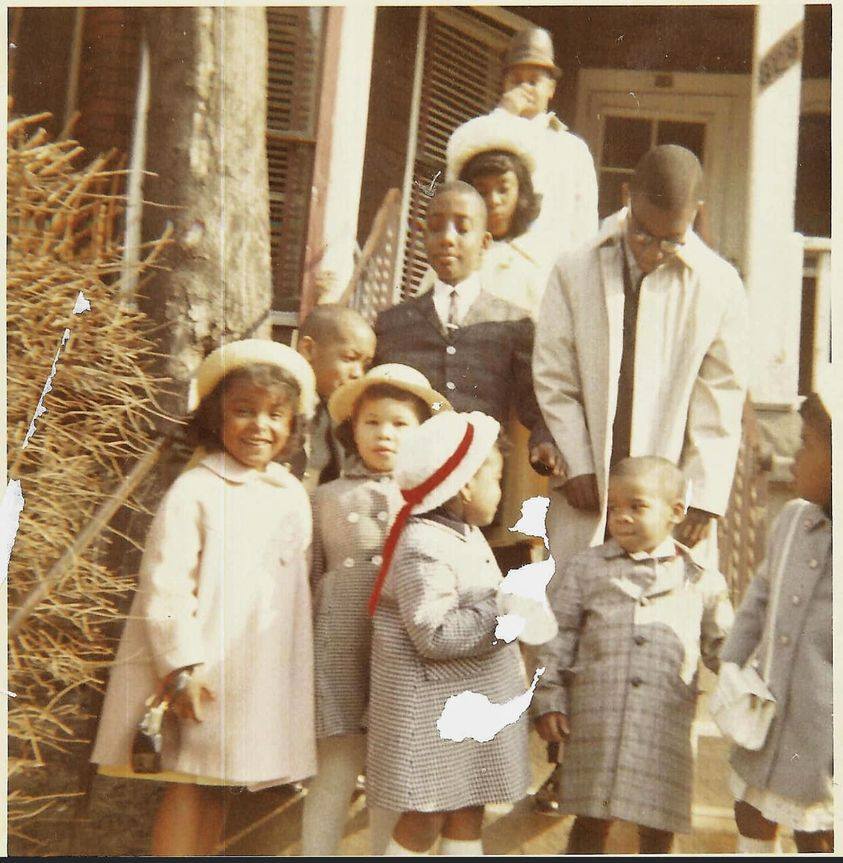
On Easter Sunday, after family breakfast (Image: supplied by Ms LeGrande)
Mr Ogden’s youth also orbited around religion and music, two themes that crop up again and again in Fences. “My mother was the daughter of a Methodist preacher,” said Mr Ogden. “In her mind, her children were talented, they could sing, and so she would gather us around the piano, we were young, and she would teach us songs and we would sing. And that started…when I was seven or eight years old.”
Another two themes central to Fences are the complexity of social mobility and the power of education. Troy Maxson, the play’s protagonist, is torn between wanting a better life for his children and wanting to protect them from the disappointments he himself has faced.
Mr Ogden, a lifelong worker in the education sector, says his own upbringing was also shaped by the opposing forces of hope and prejudice.
“My mom and dad, as you could see, were very education conscious. My dad didn't want his kids coming into the steel mill behind him – he was in the steel mill, and even there jobs were limited. … In the 1950s, there was still a lot of discrimination, and not just against African Americans, but also many of the ethnic persons who were coming in trying to get established.”
The efforts of Mr Ogdens parents and his own dedication well and truly paid off, leading him to become a leading member of the Pittsburgh community.
“I went through the system and I was first in just about everything,” said Mr Ogden. “First African American teacher, first African American principal, first African American assistant superintendent, first African American in charge of pupil personnel and other things.”
Education and its importance were also key factors in Ms LeGrande’s life on The Hill. “I lived around people and lived in a house where you are supposed to go to college,” she said. “Now here's the problem: my parents didn't have any money for me to go. So I never applied to go to university. My friends did and they went. But ‘round about the middle of June [in my last year of high school], I got a call from my school counsellor that said that there was an opportunity to go to the University of Pittsburgh with a scholarship. And that's how I went to college.”
Cory Maxson, Troy’s youngest son in the play, gives up a university sports scholarship to enter the marines. Ms LeGrande’s own family contained similar stories:
“My oldest sister also went to college and I think that was about when my father lost his job, so she only went there for a year. She had to come home and work. My brothers on the other hand… they went into the service. They both went into the Air Force, which was, if you know anything about Black history, the young man's way out of poverty.”
“When men graduated from high school, they went into the military or the steel mill or became garbage men. My brother, after he came out of the military, worked for H.J. Heinz the rest of his life, because that's what Pittsburgh had to offer.”
The second half of the twentieth century and the apogee of the civil rights movement ushered in many changes to Pittsburgh and the lives of the people who lived on The Hill and surrounds. It is now a very different place, which Ms LeGrande says ‘it's a sad change.”
Looking back, both Mr Ogden and Ms LeGrande remember their formative years in Pittsburgh with great fondness. Mr Ogden, who’s lifelong commitment to education and community-building, says that it all started in his childhood years. “It was always family and that means a lot,” he said. “I even see where that's carried over to my children and grandchildren, that disciplined, respectful, purposeful life, I've seen all that carried over.
Ms LeGrande said despite the hurdles that she and her contemporaries faced, The Hill was a great place to grow up. “Well, I realised I was poor when the lights would go out. But I didn't really…” she said. “We had everything. We actually had everything we needed in this community and on The Hill. Because it was a thriving community.”
On a hopeful note, Ms LeGrande said that The Hill is in the process of a revival:
“I still have relatives in Pittsburgh. I learn from them that the Black Community of Pittsburgh is beginning to thrive again. My home in the Upper Hill no longer exists, but new homes and businesses are being built. Young people who stay appear to be bringing a new beginning to the 'burgh'. In my youth, we were not allowed to swim in certain areas...I would never have thought then that Pittsburgh would have a Black Mayor as it does today.”
August Wilson's Fences is on stage now at Wharf 1 Theatre until 6 May 2023.

