
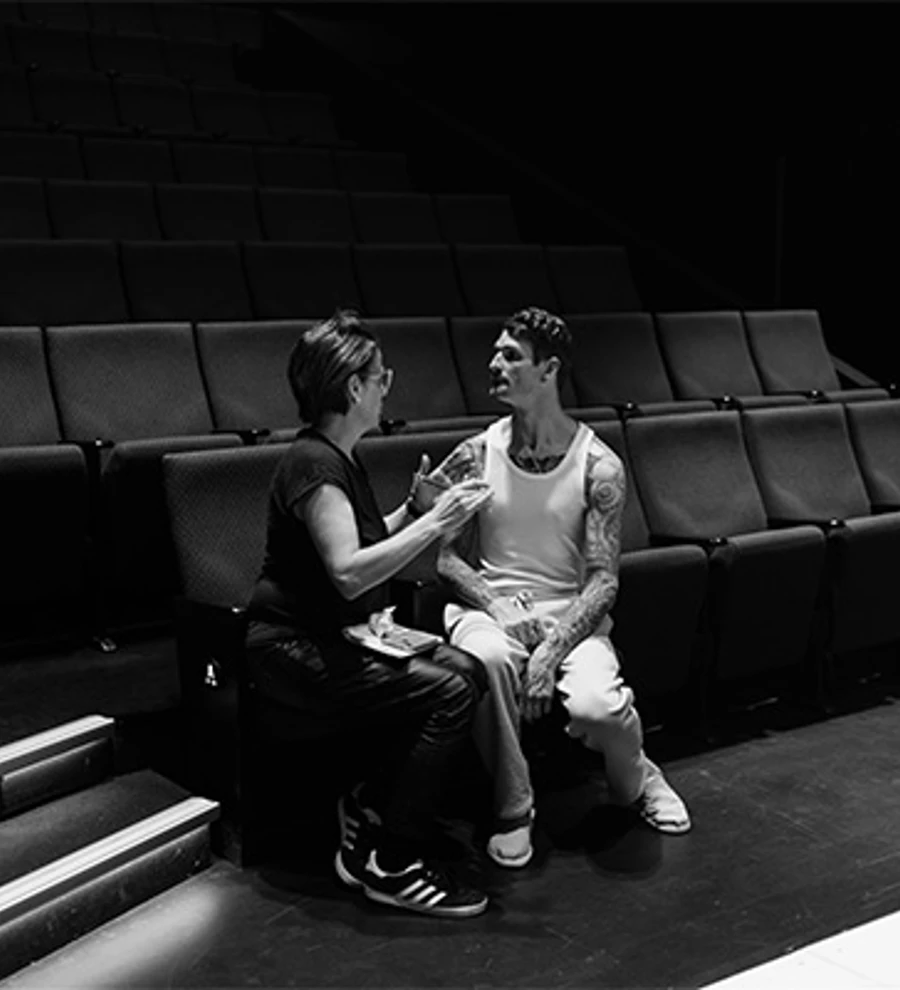
Can you tell us about how this show came to be?
Priscilla: I first met Dan when I saw his incredible show Beast at Sydney Festival in 2018. I was so moved by his performance that I tracked him down and asked if he wanted to meet for a coffee before he flew back out to the UK, where he was living. We stayed in loose contact, and eventually in 2019 I came across Cost of Living by Martyna Majok. I could not believe it because the character of John felt like it was created for Dan to play. I sent Dan the script and he wrote straight back to me. I will never forget his email, he said “I f***ing heart this. I want in – let’s do it!!”
Can you tell us a little bit about the four characters and their intertwining stories?
Dan: At its core, this extraordinary piece of writing highlights the importance of interdependence in the disabled lived experience. The world is as beautiful as it is harsh and the characters are all, in their own ways, doing everything in their power to find shelter in each other. The thing I keep coming back to, particularly looking at the relationship between Ani and Eddie, is Ani’s longing as a disabled person to be alone, to be away from her husband, after years of being with him, but that solace coming at a cost, because she needs him for her day–to– day care. At the same time, on the other side of town, we meet John who has found himself alone for the first time and is recruiting a personal assistant to help him with his daily care. Jess has “lived a lot of life” after working the night shift at bars around town. She first meets John in his apartment in the hope she can be of help to him, and in the hope that he can be of help to her. As much as this is a play about the help disabled people need to live in the world, it is also a play about the help non–disabled people need. Disabled people are generally categorised as having little worth in society and it’s a beautiful thing to be with Eddie and Jess as the two non–disabled characters, to see how much they actually need and want Ani and John to be part of their worlds. Without Ani, life for Eddie was tough and before meeting John, life for Jess was survival. What makes this show different to any other show you’ve worked on?
Dan: It’s quite a monumental thing, as a disabled artist, to be even working on a play for an Australian state theatre company. It feels like a total gamechanger to be working alongside this extraordinary team of artists to bring a story like this to Australian audiences. A real strength of this collaboration has been the time we have been able to take in bringing this work to life. We’ve left no stone unturned in the five years it’s taken us, with many careful conversations and considerations around accessibility, inclusion, and care along the way. It’s a very rare thing to be afforded the luxury of time in today’s day and age, which is why it’s distinctively different from any other show I’ve worked on.
How has this informed the rehearsal process?
Priscilla: As artists, we always talk about how collaborative theatre–making is. But for me, never have I been involved in a process that is as intricately, and supremely collaborative at every single stage, as this production has been. This is not only because we are the first mainstage production in the country to have a 50/50 ratio of disabled/non– disabled actors on stage and almost this same ratio represented amongst our creative team. It requires a design which must be entirely accessible, that must transition effortlessly between the intimacy of bathroom spaces to busy Jersey City streetscapes. And a text that necessitates a heartbreakingly beautiful sound score with stunning, sophisticated lighting. We are so grateful to the creative team, including Michael Scott–Mitchell, Guy Webster, John Rayment, our stage management and production teams led by Grant Gravener and Dan Maddison, as well as the Queensland Theatre programming team led by Helen Hillman and Pip Boyce, who have collaborated with absolute dedication, flexibility, and skill in order for us to achieve our collective vision for the work.
Can you tell us about the experience and process of co–directing a show with another person?
Priscilla: I think all of us on this project are acutely aware of how extraordinary our rehearsal room and process has been. We are all aware that as a company we collectively represent a range of spheres of experience on this production and it is our differences – coming together, working, listening, responding to one another – that inform a deeper and richer work. Dan and I as co-directors are testament to that, and this is partly why we chose to co-direct the work. We celebrate the different perspectives we bring from our different lived experience, from our different artistic practice, from our differing bodies of creative work.
What message are you hoping the audience will take away from this show? Why is this an important story to see on the stage?
Priscilla: We are aware that there is an advocacy element to this work, and we are so proud to be supported in a co-production by Queensland Theatre and Sydney Theatre Company. This is a work that invites conversation around the complexities of who we are as humans, and how we co-exist. This is not a play that allows audiences to position themselves at arm’s length from the world of the characters. To somehow think “well that’s about disability – that is not me”. Because actually, Majok is saying the reverse – this play says, “this is all of us.” In this way the notion of ‘disability’ as ‘otherness’ is completely turned on its head. Our goal has always been to make an astonishing theatrical experience for our audiences that celebrates our human connection.