
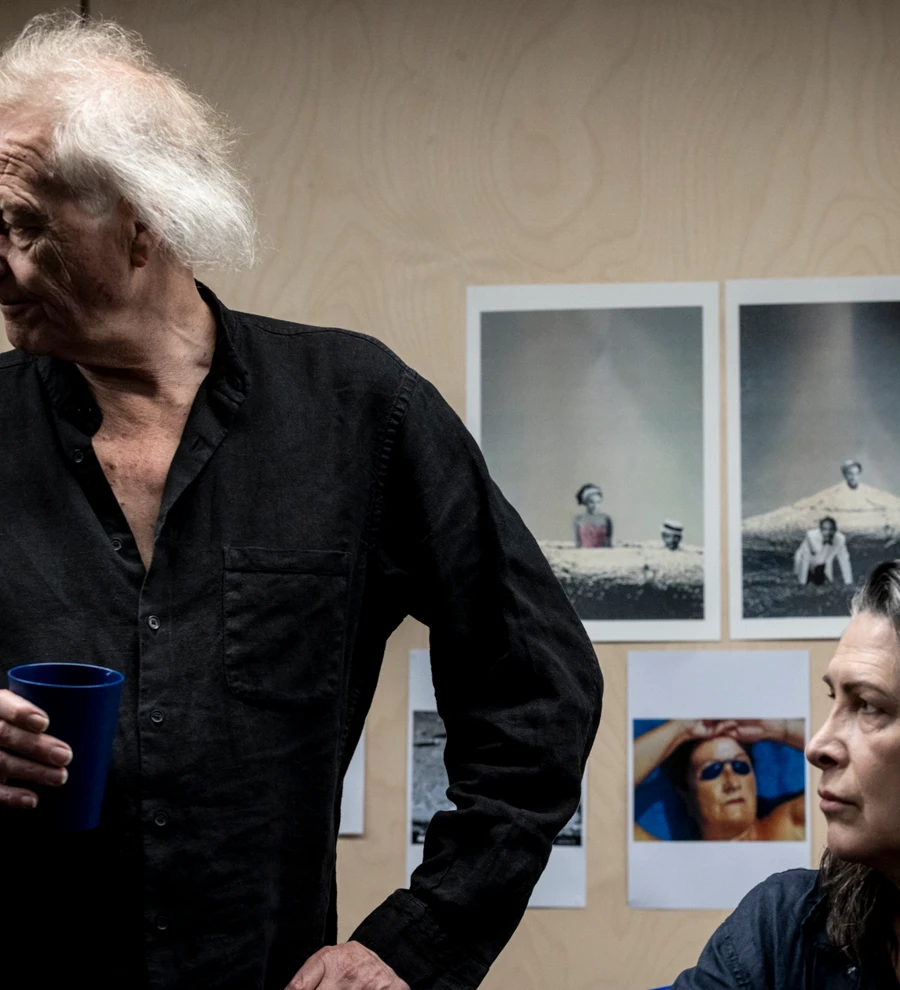
Pamela Rabe and Nick Schlieper on the universal themes in Happy Days.
When we first started to talk about making this production of Happy Days, we began with the usual question – why now? What does this play written 64 years ago have to say to us today? In seeking to answer this fundamental question, we pondered the many ways in which you could approach the text, the most obvious of which would be through the lens of climate change. Or post some unspecified holocaust. Or amongst the aftermath of a society choked by its own insatiable appetite for consumerism. Or even the end of Empire. The list of possibilities goes on. The text abounds with allusions to all of these readings, indeed an earlier draft more than hinted at a cataclysmic war and the play is redolent with the ramifications of climate change. Our short answer was that the play is still replete with relevance for this time and in some ways feels even more urgent, given the uncertainties of our current world.
However we decided that to take any single one of these approaches was ultimately reductive. It narrowed the play’s scope, and it would actually shift the focus away from the universal and towards the specific. It’s no coincidence that throughout the eight drafts that Beckett worked through, he continued to strip out any specificity hinting at an actual scenario and focussed ever more on the quintessential. At its heart this work is about how human beings persevere and survive, even in the face of the most daunting conditions, whatever form those might take. To specify the particular nature of Winnie’s circumstances was to do a disservice to the much broader metaphor at the centre of the text – which in a nutshell is simply the story of an individual’s struggle to find a way of surviving in a situation that is not of their own making. And while most of us will presumably never find ourselves literally trapped inside a mound, who can’t identify with that feeling?
Therefore, we’ve chosen to place our Winnie and her Willie in an unspecific, timeless wasteland; a landscape stripped of all features, a landscape of the mind, rather than of any particular time or place. In this mindscape, we witness an extraordinary act of human perseverance, an examination of the human spirit in the face of erasure, where Beckett tests the very limits of human endurance even as memory, identity and ultimately time itself, crumble away and slip from the grasp.
As we continue to forensically comb through this text, it’s been fascinating to discover how perfectly logical it actually is. How much sense it all makes. Something that at first reading seems to be riddled with absurdities set in the context of a surreal metaphor, turns out to be both quite logical and terribly, movingly real. Because ultimately, we’ve all found ourselves in some version or other of Winnie’s dilemma, trapped in a life that we’d never have chosen - if we’d had any choice.
Photo: Brett Boardman