
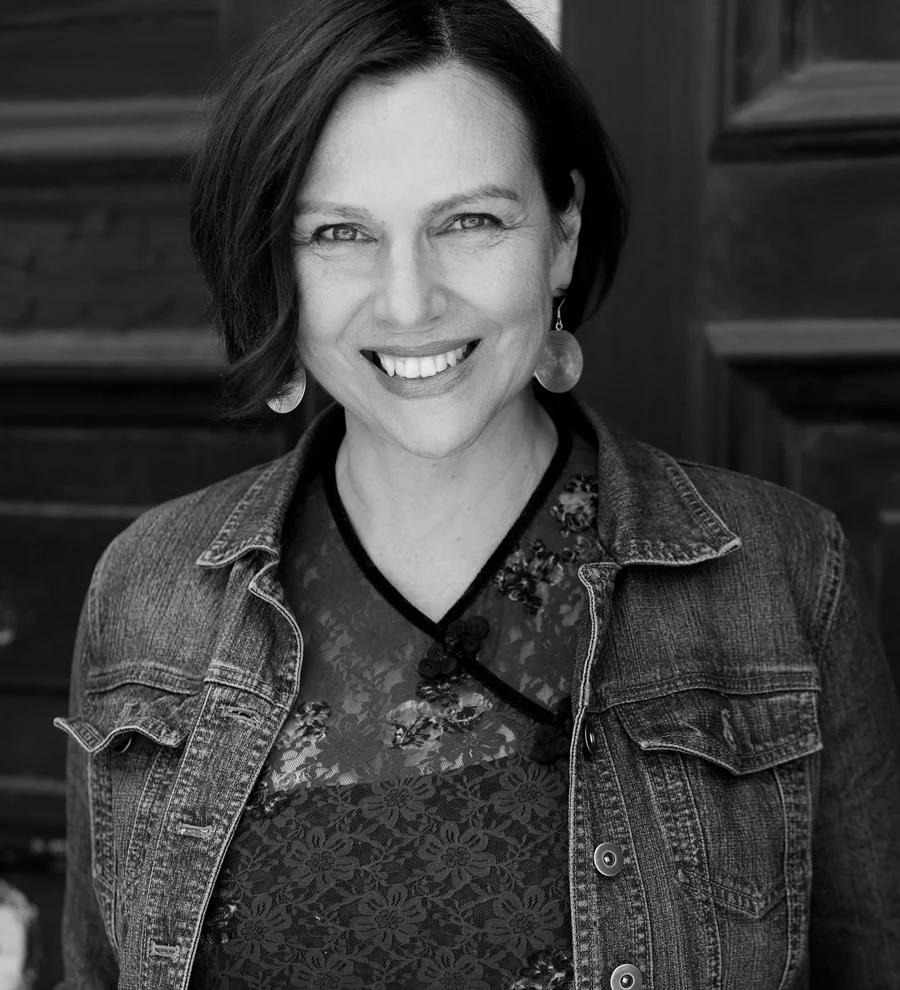
Author of The Dictionary of Lost Words, Pip Williams, shares how her New York Times bestseller came to be adapted for the stage.
In 2015, or thereabouts, I read a book called The Surgeon of Crowthorne. It is a non-fiction book written by Simon Winchester, and it is, in part, about the making of The Oxford English Dictionary. It got me thinking about how language has been defined, how it has been moderated, corralled, and controlled.
It made me wonder if some words had been left out of the dictionary – words that had never been written down, words that were spoken by women in the birthing room, the scullery, or the laundry. It made me wonder if The Oxford English Dictionary might be a gendered document, and whether that mattered.
Then one day I imagined a little girl called Esme, hiding beneath the sorting table in the Scriptorium where all the words of the English language were being defined. It was July and I remember the heat from our fire and my green notebook propped on my knees. I remember writing word after word, line after line, paragraph after paragraph. I remember describing the shoes of all the lexicographers, a dusty shaft of light, and a word falling from the edge of the sorting table. Over the next two years I spent hours in the reading room of the State Library of South Australia leafing through beautifully preserved volumes of the OED to find words that would matter to Esme. I travelled to Oxford and got lost in the archives of Oxford University Press, and I wandered down streets and into buildings that would have been familiar to Esme. I wrote a story called The Dictionary of Lost Words, and in 2020 it was finally published, straight into a pandemic.
I thought it would go gently into this new world, be read by a few word nerds, and then settle on a shelf somewhere and become dusty. But that isn’t what happened. The book found its way into the hands of readers all over the country, and all over the world. They read it and shared it, and someone passed it on to Mitchell Butel, who was then Artistic Director at State Theatre Company South Australia.
Early in 2022, Mitchell called me. He invited me for coffee and suggested my book be adapted for the stage. He was excited and optimistic and keen for it to be a co-production with Sydney Theatre Company. In that moment I imagined I was that little girl under the sorting table, and something precious had just fallen into my lap.
When playwright, Verity Laughton, agreed to adapt it, I was relieved my story would be in such safe hands. And when I found out that the director would be Jessica Arthur, I couldn’t have been happier. I knew these women would understand the story I had told, and why I felt compelled to tell it. But more importantly, I knew these women would take my story and make it their own.
I have had the unique and wonderous experience of seeing this play come to life. I’ve attended workshops and rehearsals and sold-out seasons in Adelaide and Sydney. I’ve been overwhelmed by the generosity of so many people who have brought their passion, experience, creativity, and craft to the telling of this story. From the stage design to costume, lighting, sound and visual effects, no detail has been overlooked, and each element supports the most talented cast. Together, they have animated the story I put on the page. They’ve added colour and texture, movement and sound, nuance and understanding. They’ve created something beyond my imagination, and it is a joy to sit in the audience of a darkened theatre and watch it unfold.