
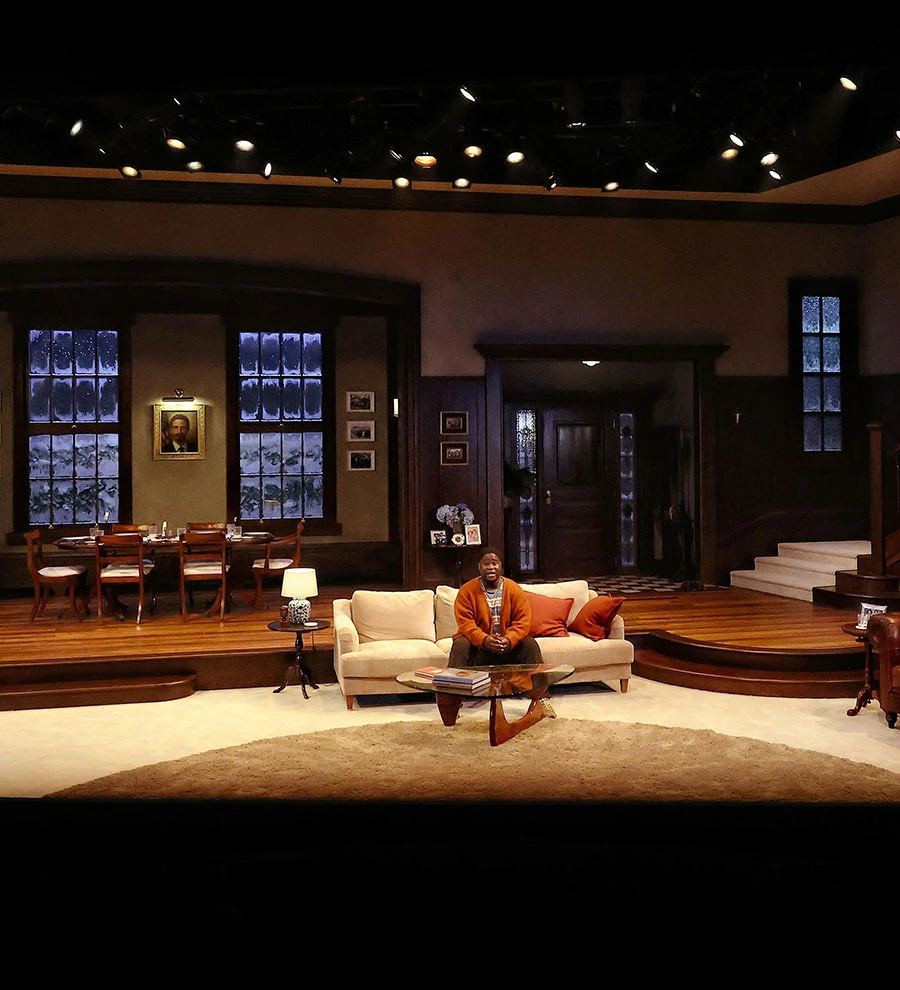
Set and costume designer Jeremy Allen is the creative mind behind some of Sydney Theatre Company’s most beautiful shows in recent memory – from The Normal Heart to Dear Evan Hansen. Now, his stunning work on our new production of Branden Jacobs-Jenkins Purpose is wowing audiences all over again. He sat down with us to discuss the process of creating this stunning set from concept to execution.
Where did the design journey for Purpose begin?
Designing Purpose began with research, specifically into stately homes in wealthy Chicago districts, specifically Jackson Park Highlands – the direction we went down was evocative of places like the Wrigley Mansion, or the Obama-Era White House Residence interiors. Purpose is loosely based around the family of a certain civil rights icon – and so there was some investigation into the home and style of this particular family.
Does the play script give a precise description of how the show should look or are you free to interpret it? What angle did you and Zindzi Okenyo add in the design?
Branden absolutely gives a quite precise description of the space – down to the style of furniture or the art on the walls. Which is, of course, very helpful! As with any production design though there is license to interpret this description however we like, and Wharf One comes with its own requirements in terms of space - for example, it is a relatively low venue, and the script calls for a grand staircase. For Zindzi and I, we wanted to make sure the space felt expansive, stately; an embodiment of Black wealth. There's a sense in the script that the house should feel curated, almost like a museum – and given the play is so much about the idea of 'persona' and public perception, it felt vital to create a space which almost felt like a display home, where each design choice is considered.
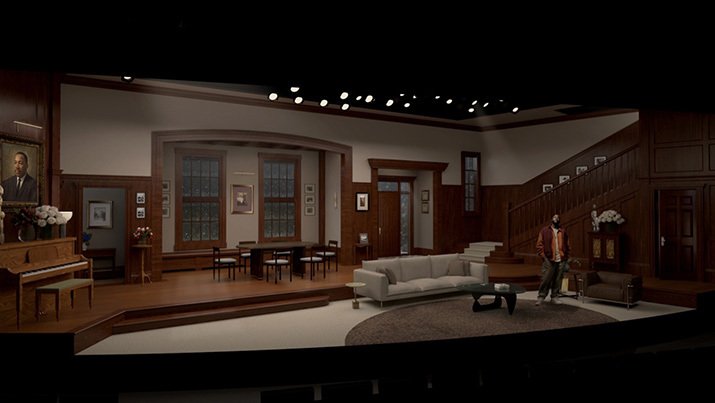
Take us through the first stage of design – presumably the digital render – how do you get this stage complete?
For me, my first stages are pencil sketches, before we even get into three dimensions – these are usually quick and partial, say, the dinner table with tall snowy windows behind, or a basement door below a staircase. From that, I'll start to put some shapes into a plan and then build up from there in three dimensions in 3D CAD. It's a very quick and easily adaptable way to experiment with space, so we can try lots of different versions or tweak the concepts until we settle on one that works. I'll then use rendering software to create an evocative image that can hopefully express the atmosphere and feel of the production, as well as show the set in detail –and also be true to plan and scale.
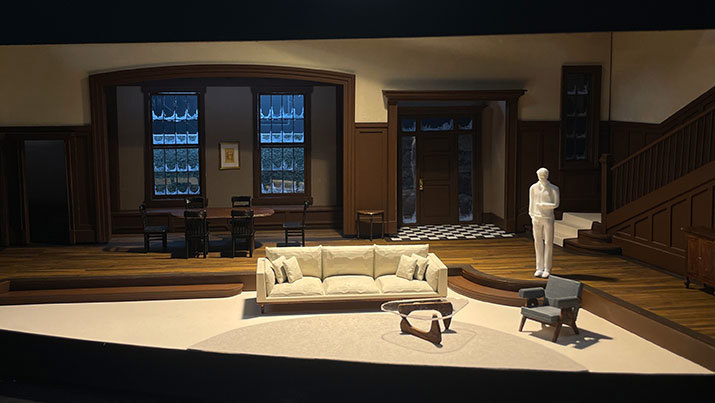
Next is model building – do you build the model yourself? How does the model stage aid in the design process?
I'd say model-building takes up the bulk of my work hours when it comes to set design – it's a laborious process, but an enjoyable one. A fully rendered model can take several weeks to make! The model is a useful tool in sharing the design with the director, production management, the set construction team and scenic art. Often when it comes to construction it's a very clear way of being able to look at all the elements together - how they interact, how they are supported, where the engineering challenges might be. In the rehearsal room it's a useful tool to establish blocking, check sightlines, and discuss lighting and technical integration.
How do you make sure that the materials/colours/textures you use during the model stage are rebuildable in real life?
Usually, you'll reference true-to-scale materials and textures first and then 'miniaturise' them for the model, particularly in something relatively 'natural' as Purpose. There are certainly more expressive textures and materials you can incorporate in the model-making phase - like, say, painting a cloth with expressed brush strokes or evoking a certain organic texture - that often spurs a discussion with the geniuses in Scenic Art – who really are masters of their craft, and are the best and recreating materials and finishes out of not much more than paint. I'm extraordinarily lucky to work with them!
Take us through the process of realising the set in real life, from model to stage.
So from the first iteration of the model, or what we call the Preliminary Design phase, the set is costed and any alterations are made to make the design sit comfortably within an allocated budget. Usually this means the incorporation of stock items - things that the company can re-use, in order to bring costs down. This can sometimes shift the design considerably. From that phase it then moves into a Final Design, which is a fully rendered model, digital renders, and a set of design drawings, which the drafting team will then take and break down into construction drawings ready for the workshop to build. The workshop then commences build, often from the floor up - floors and flats will be cut and made and then passed on to the Scenic Department, who work their magic. Often then we'll do a fit-out in the workshop before the set moves into the theatre, which is always exciting - it's when you really start to see the set come together. Everything then gets sent down the wharf (or across the road or harbour!) and re-assembled in the venue, where final fittings and set dressing happen – et voila!
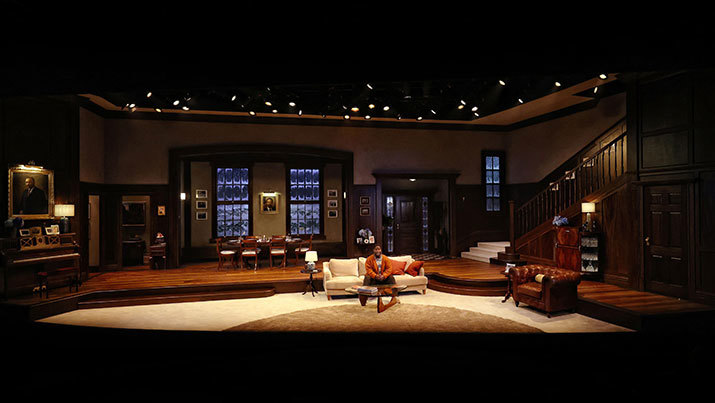
It's remarkable how similar the set looks across these three iterations – is this a common occurrence? Were there any elements that were particularly tricky?
It's not always common, no! We were very lucky that the company could see the vision and did their best to get the design as close to the original concept as possible. The challenge is always a balance between designing within the means of the company and also the needs of the play – it often requires a certain level of adaptability and flexibility. The original Purpose designs, in fact, had a ceiling component that was ultimately cut due to cost – but I don't know if I miss it!
Take us through a couple of your favourite design moments in Purpose – why do you love them?
I think there are several – the first glimpse of falling snow through the windows (which always reminds me of those classic American holiday films of the 90s!), Morgan's entrance to the family dinner, Aziza appearing at the door. I think some of the strongest moments are when Zindzi has used the space through blocking to convey emotional distance – the final scene with Solomon and Nazareth, set at opposite sides of the stage, and the house, a symbol of legacy, history and power, set between them like a chasm.
Purpose is on stage at Wharf 1 until 22 Mar 2026. Purchase your tickets now.